

Published date: 04th Nov, 2026
TL; DR
- The ride-hailing market is expanding with urban micromobility solutions like e-scooter sharing platforms.
- Platforms like Lime, Bird, Bolt, Voi, and others are dominating the shared micromobility market with proven business models.
- Discover the comprehensive process to start an electric scooter sharing business, from choosing a business model to feature selection.
- Explore how self-hosted software like VivoCabs can help businesses establish and scale an on-demand electric scooter sharing business.
The global and regional electric bike and scooter sharing market is experiencing accelerating growth driven by rapid EV adoption, urban congestion, and sustainable initiatives. For entrepreneurs, this presents a lucrative opportunity to launch an e-scooter sharing app.
However, launching an efficient electric scooter-sharing business requires entrepreneurs to create a blueprint in advance that includes a well-defined operating model, targeted demographics, managing fleet utilization effectively, local regulatory compliance, and building a reliable digital platform. By defining a startup strategy early, businesses can avoid substantial upfront investment in unnecessary implementations.
With this in mind, this blog is written for entrepreneurs looking to build an electric scooter-sharing business. Below, you will explore a detailed breakdown of the key considerations involved in building an e-scooter sharing platform.
What Is an Electric Scooter Sharing Business?
An electric scooter-sharing business provides an on-demand bike-sharing service that gives users temporary access to e-scooters for short trips, usually through a mobile app.
This business works like a taxi service, except the riders drive the scooter themselves.
Here is a brief overview of how the electric scooter business works for the user:
- Users register on the app
- Find a nearby scooter.
- Unlock it.
- Ride to the destination.
- Park it and pay digitally.
- Where scooters are left: Depending on the business model, riders either park the scooter anywhere inside an approved area (a service zone) or return it to a fixed station.
- What the Business handles: Business owners are responsible for fleet management. They can manage the availability of scooters, keep track of their repairs, and pricing through the admin dashboard.
- Note: Starting an electric scooter sharing business does not mean businesses have to own multiple fleets or stations; they can partner directly with local bike manufacturers, regional fleet suppliers, and local service stations to source, maintain, and station vehicles.
How an e-scooter sharing business makes money:
- Per-minute charges
- Unlock fees
- Ride packages
- Subscriptions
- Contracts with hotels, universities, and corporate campuses
For entrepreneurs, the opportunity is not simply to put scooters on the road. It is to build a reliable local mobility service that meets a specific transportation need and can operate sustainably.
Top Electric Scooter Sharing Business
Evaluating established operators can help entrepreneurs understand different approaches to fleet management, market selection, customer experience, and geographic expansion. Below, we have curated top ride-sharing apps that are useful examples of the shared micromobility market; however, their availability and operating models may vary by city and country:
1. Lime
Lime is a prominent shared micromobility operator offering electric scooters and e-bikes in markets around the world. Its model demonstrates the importance of app-based access, fleet operations, and integration with local transportation networks. Lime is a useful competitor to study when evaluating customer onboarding, vehicle availability, and how shared vehicles can support short urban trips.
2. Bird
Bird provides shared e-scooters and other micromobility options in selected markets. Its experience illustrates how operators must balance vehicle deployment, maintenance, rider safety, and relationships with cities. Entrepreneurs can study its product positioning and operational approach while checking which services are currently available in their target locations.
3. Voi
Voi is a European micromobility operator known for shared e-scooters and e-bikes. It is a relevant example for businesses considering partnerships with cities, parking management, safety practices, and the role of shared mobility in connecting riders with public transport.
4. Dott
Dott operates shared electric scooters and e-bikes across numerous European and Middle Eastern cities. Following its combination with TIER, the company illustrates how operators may consolidate brands, fleets, and technology to expand coverage and improve operational scale.
5. Bolt
Bolt offers shared e-scooters in selected markets alongside its broader mobility services. Its presence across multiple mobility categories demonstrates how scooter sharing can sit within a wider transportation ecosystem, although the services available differ by location.
6. Neuron Mobility and Beam
Neuron Mobility and Beam are known for shared micromobility operations in Asia-Pacific and other selected markets. Their market experience highlights the importance of adapting vehicle operations, local partnerships, and safety practices to each city.
Ready To Establish an Electric Scooter Sharing Business Online?
Step-by-Step Process to Start an Electric Scooter Sharing Business
Starting a micromobility platform involves several crucial stages, and every step within those stages counts toward a successful start. To start an electric scooter business, your strategy should reflect local transportation needs, competition, available investment, and operational requirements.
With this context in mind, let’s explore the key steps to starting and building your own electric scooter-sharing business:
Step 1. Research Your Target Market and Identify Demand
Market research should be one of your first steps. It helps gaining ideas about the business scope. It covers several aspects like suitable demographics, user requirements, competitors’ experience, gaps, and so on. Having a clear understanding of the market serves as a foundation to set up an e-scooter business efficiently.
Start by identifying the transportation problems you have. For example, whether users need an affordable alternative to short taxi rides, a convenient way to reach public transportation, or a flexible transportation option within a university campus or tourist destination.
Evaluate the local market and start identifying the transportation gaps and opportunities based on the below-mentioned categories:
- Analyze potential customer group: Consider office commuters, university students, tourists, residents of densely populated neighborhoods, and visitors to large commercial developments. Each group has different travel patterns, price expectations, and usage frequencies.
- Study existing competitors: Analyze other scooter-sharing companies, bicycle-sharing services, ride-hailing platforms, and local rental operators. Examine their service areas, pricing structures, vehicle availability, customer reviews, and operational limitations.
- Assess transportation infrastructure: Target areas with suitable roads, cycling infrastructure, pedestrian access, and convenient parking.
- Estimate demand Patterns: Analyze demand patterns by location and time. A business district may experience strong weekday demand, while a tourist destination could see more weekend and seasonal activity. Understanding these patterns helps you plan fleet distribution and staffing.
- Market Validation: Conduct short surveys and pilot programs for audiences, and participate in community discussion platforms to validate demand before you make a substantial investment.
Step 2. Choose the Right Electric Scooter Sharing Business Model
A company’s business model determines its target users, access to scooters, how operations, fleets, and vehicles are managed, and how revenue is generated.
There are several business model approaches worth considering, such as:
- Dockless Scooter Sharing
Dockless services allow customers to pick up and leave scooters at approved locations within a defined service area, subject to local parking rules.
This model offers greater convenience because customers do not necessarily need to return scooters to a dedicated docking station. However, it requires effective fleet tracking, parking management, redistribution, and control over where rides can begin and end.
- Station-Based Scooter Sharing
In this model, scooters are stored at designated stations or docking points. Customers collect and return vehicles at approved locations.
Station-based operations make fleet organization and parking easier, especially in controlled environments. However, for docking infrastructure, businesses can select locations carefully or contact any local service station providers.
- Business-to-Consumer Scooter Sharing
A business-to-consumer (B2C) model serves individual riders who pay to use scooters for personal transportation.
Revenue comes from pay-per-ride charges, time-based pricing, subscriptions, or prepaid ride packages. This approach can work well in urban areas with frequent short-distance travel.
- Business-to-Business Scooter Sharing
A business-to-business (B2B) model involves providing scooter-sharing services to organizations such as hotels, universities, residential communities, corporate campuses, and tourist operators.
B2B arrangements create more predictable demand through contracts or fleet agreements. However, pricing, service responsibilities, and vehicle availability must be clearly defined.
Choose a model that matches your market research, available capital, operating capacity, and target customers. You can also combine models as your business grows.
Choose a Suitable Business Model for Your On-demand Scooter Sharing App
Step 3. Understand Regional Regulations
Regulatory compliance is essential because electric scooter-sharing services operate in public spaces and involve road safety, vehicle access, parking, and rider liability.
Requirements vary by country, state, city, and sometimes individual operating zones. Rules for privately owned electric scooters do not apply to commercial sharing fleets.
Must investigate the following areas while finalizing your micro mobility sharing startup strategy:
- Business registration and any permits required to operate a sharing service.
- Vehicle classification, registration, and equipment requirements.
- Rules concerning minimum rider age, helmets, speed limits, and permitted roads.
- Public-space, parking, docking, and fleet-size restrictions.
- Requirements for operating on university campuses, private property, or commercial premises.
- Rider terms, liability provisions, and consumer protection obligations.
- Data protection, payment security, and digital consent requirements.
- Insurance coverage for third-party liability, vehicle damage, theft, and other operational risks.
To manage the fleet smoothly, businesses need agreements with property owners or local authorities to place scooters in designated areas.
Consult local transport authorities, legal professionals, and insurance providers before committing to a launch date. Compliance should be part of your business plan and technology requirements from the beginning, not an issue addressed after the service goes live.
Step 4. Define Your Revenue Strategy
Revenue streams incorporated in e-bike sharing apps should balance affordability for users and the cost of maintaining and operating your business.
Consider the following revenue models.
- Per-Minute Pricing: Charge users to pay as per the duration of their ride. This can suit short urban trips but requires clear billing rules and transparent pricing.
- Unlock Fee Plus Ride Charges: Put an initial fee on users to start a ride and an additional charge based on duration or another defined measure.
- Fixed-Price Rides: Users pay a predetermined amount for an eligible trip or journey type. This can make costs easier to understand when the operating conditions are predictable.
- Subscriptions and Ride Packages: Frequent riders can purchase memberships, monthly plans, or bundles of rides. These options may encourage repeat usage.
- Corporate and Institutional Contracts: Organizations can pay to access fleets or a managed transportation service for their employees, residents, students, or visitors.
- Tourism and Hospitality Partnerships: Hotels, resorts, and tour operators can use the app to offer scooter fleets to their guests. Visitors open the app to find a nearby scooter, unlock it, and travel around the destination on their own, without needing taxis or fixed tour schedules.
Evaluate prices against local alternatives and the user’s willingness to pay. Businesses should also determine how to handle refunds, cancellations, idle time, damaged vehicles, and penalties for parking violations where permitted.
Review performance regularly. Ride frequency, average trip duration, revenue per scooter, customer retention, and maintenance costs can help you identify whether your pricing model is sustainable.
Step 5. Finalize the Key Features of Your Electric Scooter Sharing App
A mobile application is the main user touchpoint for an electric scooter-sharing service. It allows riders to discover available vehicles, access ride information, and complete transactions without relying entirely on manual processes.
Your app should be designed around the actual journey a user follows. For that, focus on integrating user-friendly features in the app that lead to smooth functionality at every stage, from registration to ride completion.
Must-Have Features in an e-Scooter Sharing App :
- User registration and profiles: Allow users to create accounts, manage personal information, and review their ride history.
- Map-based scooter discovery: Display available scooters and relevant service areas so riders can find a convenient pickup point.
- Scooter availability and details: Show useful information such as battery level, vehicle status, and estimated ride availability when supported by the fleet technology.
- Ride booking and access: Enable riders to reserve or initiate a ride according to the operating model.
- Digital unlocking: Integrate the app with compatible electronic locks or scooter hardware to authorize access. This functionality requires suitable device-level integration.
- Payments and billing: Support appropriate payment methods, transaction records, receipts, and clear pricing information.
- Ride tracking: Provide ride status and relevant trip information, subject to the capabilities of the tracking hardware and software.
- Ride completion: Allow riders to end a trip and follow applicable parking or return instructions.
- Notifications and support: Send relevant service notifications and provide a way to report problems or contact customer support.
While these are some relevant electric scooter sharing features a business must include in the app, there are more considered features that lead to high-end functionality on the app, like-
- Fleet management interface
- Administrative dashboard
- Operational reporting tools, etc.
Also remember, the feature set should reflect your operating model. A dockless service with electronic locks and automated ride termination may need a different technical architecture from a station-based rental business.
Step 6. Choose the Right Development Approach
Based on your business requirements and budget, decide the correct development approach. The two main approaches are custom development from scratch and customizing a ready-made software platform.
Given below is a brief overview of both development approaches:
1. Custom Development From Scratch
Custom development means building the platform around your requirements from scratch. It is an ideal choice when your business needs a highly specialized operating model, a unique technical architecture, or complex integrations that existing platforms cannot support.
However, for this approach, businesses have to invest in a full development process, which often takes time and needs a flexible budget. It covers end-to-end stages, including-
- Requirements Analysis
- Interface Design
- Backend Engineering
- Mobile App Development
- Integrations
- Testing
- Deployment
- Security Updates
- Ongoing Maintenance
The scope can grow as new requirements emerge, so timelines and costs may be harder to control.
Building from scratch also means that the business has to establish and validate core workflows before it can focus on features that differentiate its service. For a new operator still testing local demand, this can create a substantial upfront commitment before the business model has been proven.
2. Readymade Software With Customization
For many entrepreneurs, readymade software is a more practical starting point. Instead of building every foundational component independently, the business starts with pre-built software and adapts it to its brand, operating model, and required workflows.
Depending on the solution, existing software already provides building blocks for user accounts, mobile app interfaces, ride-related workflows, payments, administrative controls, and reporting. This can reduce development effort and allow the project team to focus on the specific requirements that make the scooter-sharing app work.
Key advantages of investing in ready-made software can include:
- Structured Launch Process: Start from an existing software foundation rather than beginning every component from zero.
- Lower Initial Development Effort: Reuse suitable capabilities instead of commissioning equivalent features individually, although total costs depend on licensing, customization, and integrations.
- Faster Path To Validation: Focus the project on the essential workflows needed to test the business in a limited service area.
- Brand and Workflow Customization: Adapt the app experience, business rules, and administration to the intended audience and operating model.
- Room To Expand: Add features and integrations in phases as real usage data clarifies what customers and fleet operators need.
Launch a Customizable Electric Scooter Sharing App With VivoCabs
For entrepreneurs and businesses planning to enter the electric scooter-sharing market, VivoCabs is worth considering as a foundation for a customized mobility platform.
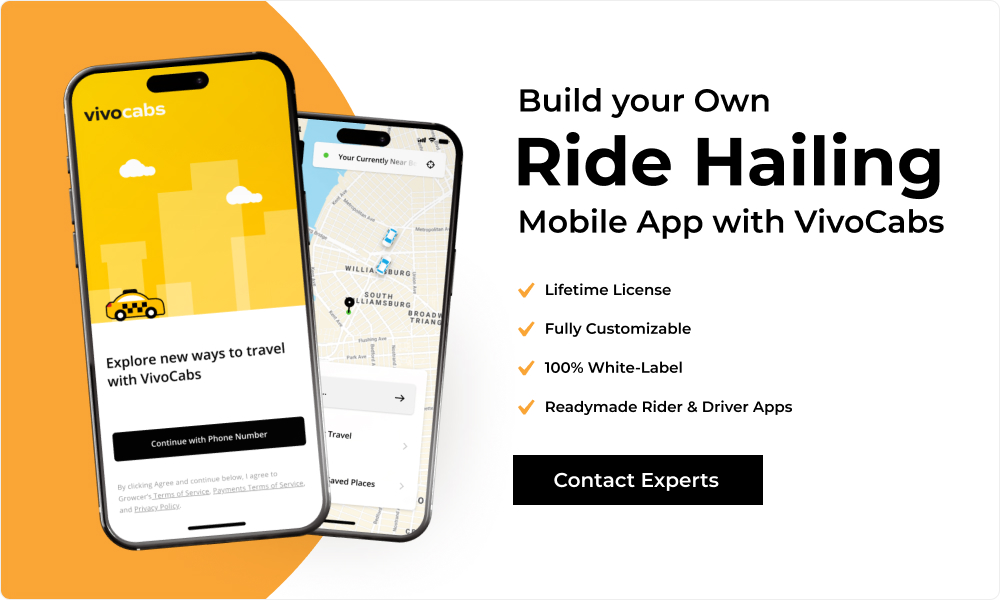
VivoCabs, developed by FATbit Technologies, is a white-label ride-hailing software solution designed to help businesses launch white-label mobility platforms. Its technology foundation includes 2 app types (rider-facing and driver-facing)alongside an administrative dashboard. Though it comes with a pre-built ecosystem, businesses can tailor it to align with their operating model and business requirements. Once entrepreneurs decide to go with VivoCabs, the next objective should be to assess how it could be adapted to support an e-scooter sharing business. The platform already includes the core features of a taxi app, and further features can be added as needed.
Scooter-specific features would need particular attention. These may include electronic unlocking, battery-status monitoring, hardware-level GPS integration, geofencing, charging or battery-swap workflows, and automated ride-ending rules. Their feasibility depends on the selected scooters, available hardware interfaces, APIs, and the scope of customization.
If you are aiming to start an electric scooter-sharing business, VivoCabs is a suitable starting point.
You can discuss your requirements with a dedicated manager to explore more about the software, how it can be tailored to specific business goals, and how it can support your business.
Schedule a Personalized Demo To Explore VivoCabs In Action
Step 7. Launch and Scale Your Electric Scooter Sharing Platform
A successful launch requires a focused marketing strategy that introduces the service to the right audience.
Explore the following marketing practices to build visibility and trust among users:
- Begin by concentrating on a manageable service area instead of spreading your fleet across locations where demand has not been validated.
- Develop a website that explains the service area, pricing, usage process, safety policies, and customer benefits. Optimize the website for relevant local searches, such as electric scooter rental and scooter-sharing services in your operating area, where those terms accurately describe your offering.
- Use local search optimization to improve visibility for customers looking for convenient transportation. Maintain accurate business information and encourage genuine customer reviews.
- Partnerships can also support customer acquisition. Hotels, universities, office complexes, residential communities, event organizers, and tourist attractions may provide access to relevant audiences.
- Consider introductory ride credits or referral programs, but evaluate their impact on repeat usage rather than judging success by app downloads alone.
- Social media can help demonstrate how the service works, explain safety practices, and promote new operating locations. Paid advertising may be useful when targeted toward a clearly defined service area and relevant customer groups.
- Track measurable outcomes, including app registrations, first rides, repeat bookings, customer acquisition costs, and revenue per active rider.
The objective is to build a base of customers who use the service regularly, not simply to generate short-term attention during launch.
Conclusion
Starting an electric scooter-sharing business requires a combination of market research, financial planning, suitable vehicles, regulatory compliance, reliable operations, and effective technology.
Begin by validating demand in a specific location and choosing a business model that fits the transportation needs of your target customers. Moreover, estimate startup and operating expenses carefully, select commercially suitable scooters, and establish procedures for safety, maintenance, charging, and fleet management.
While building an app from scratch may seem like an attractive option, it often involves significant development costs, technical complexity, and extended launch timelines. Alternatively, businesses can consider customizable, ready-made mobility software like VivoCabs by FATbit Technologies. It is a self-hosted solution that can be tailored to different business models, with scope for customization and additional scooter-specific integrations to support the operational requirements of an electric scooter-sharing business.
Do You Have a Taxi Business Idea in Mind?
Talk to ExpertsPopular Posts