

Every month, many taxi operators face the same frustrating reality: strong effort, long working hours, and constant demand, yet limited business growth. Bookings are being managed, drivers are on the road, customers are being served, but revenue remains flat, fleet expansion slows down, and repeat business becomes inconsistent. Despite being operationally active, the business is not moving forward at the pace it should.
Here’s the uncomfortable truth: you are not failing because of competition from ride-hailing apps. You’re failing because of how you operate, specifically, because of the invisible friction that offline, manual operations create at every single touchpoint of your business. It compounds silently, every single day, until scaling becomes structurally impossible.
Many established taxi and cab businesses were built successfully using traditional methods. However, the same systems that worked during the early stages can become growth barriers in a more digital and competitive market. If scaling requires more owner involvement, more manual coordination, and more daily problem-solving, the challenge is no longer effort; it is operational infrastructure.
Table of Contents
The Illusion of Being Busy
The cruelest trap in the taxi business is confusing activity with growth. When you’re dispatching via phone calls, tracking drivers through WhatsApp, and maintaining a customer list in a spreadsheet (or, worse, your head), you feel constantly busy.
But busyness is not a business model. And the painful paradox of offline operations is this: the more rides you do, the more work you create for yourself, personally. There is no system that runs without you. There is no process that scales without hiring more people to manually replicate the same phone-and-spreadsheet workflow. You’re not building a business; you’re building a job that you can never leave.
“The goal of a business is to create a system that produces results. The goal of a job is to do the work yourself. Most offline taxi operators have accidentally built the latter.”
Every time you take a booking manually, you are bottlenecking your own business through your personal availability. What happens when you’re sick? What happens when you take a weekend off? What happens at 2 AM when a customer needs a ride, and you’re asleep? The business stops. And a business that stops when the owner isn’t watching cannot scale.
Seven Scaling Killers Hidden in Plain Sight
Let’s be specific. These are the exact mechanisms that prevent offline taxi businesses from growing, not just in theory, but in the daily operational reality of running a fleet. They include:
1. Manual Booking Creates an Invisible Ceiling
When bookings come through phone calls, there is a hard upper limit on how many you can handle. You cannot book rides while you’re sleeping. And critically, you cannot capture the customer who calls once, gets a busy signal, and never calls again. That customer is gone forever, and you don’t even know they existed.
Online booking systems don’t just add convenience, they fundamentally remove the human bottleneck from the booking process. A customer at 11:47 PM can book a 6 AM ride without ever involving you. Your business is open 24 hours. Your personal capacity is no longer the constraint.
2. Cash-Only Operations Destroy Customer Data
When every transaction is cash, you capture nothing. No customer name tied to a ride. No record of how often a particular customer books. No way to identify who your most loyal customers are. No ability to offer a loyalty discount, a referral incentive, or even a simple birthday offer. Customer data is the foundation of any scaling strategy. Without it, you’re starting from zero every single month. You cannot retain what you cannot identify.
3. Driver Management via WhatsApp Doesn’t Scale Past 10 Drivers
Below ten drivers, WhatsApp groups and phone calls are manageable. At fifteen, twenty, or thirty drivers, it becomes chaos. Who’s available? Who’s on a ride? Who’s near the airport right now? Without a central dispatch system, the answer to every one of these questions requires a phone call, multiplied across every shift, every day. Driver performance is impossible to measure without data.
4. You Have No Idea Where Your Revenue Is Coming From
Ask most offline taxi operators which customer segment is most profitable, corporate clients, airport rides, or local hourly hires, and they’ll guess. Ask them which marketing channel brought in the most customers last quarter, and they’ll shrug. It’s a structural data problem. Without digital records, you’re flying blind. Businesses that don’t know where their revenue comes from cannot consciously replicate it.
5. Pricing Is Gut Feel, Not Strategy
How did you decide what to charge per kilometre? Probably based on what competitors charged, or what felt right. Do your prices change for peak hours, high-demand zones, or special events? Probably not consistently. Dynamic pricing is not about overcharging customers; it’s about reflecting actual supply and demand. On a rainy Friday night, your fixed flat rate is leaving money on the table.
6. Your Brand Doesn’t Exist Online
Think about this carefully: if someone who has never heard of your business searches for ‘cab service in [your city]’ right now, do they find you? Do they find a professional, trustworthy-looking website where they can book? For most offline operators, the answer is no. Your entire brand exists in word of mouth, which is valuable, but which has a hard ceiling.
7. Operations Collapse Under Sudden Volume
What happens to your business operations when demand unexpectedly doubles? A major event in your city, a competitor goes offline, or a corporate client suddenly needs fifty rides a day instead of ten. For offline businesses, the honest answer is: the system breaks. And when a business fails to handle a surge in demand, it doesn’t just miss the revenue, it damages its reputation with the customers it couldn’t serve.
Eliminate Booking Bottlenecks and Grow Your Taxi Business Faster
The “Just Work Harder” Trap
There’s a particular mindset common in the taxi industry, especially among operators who built their business from scratch, that more effort is always the answer. This approach works until it doesn’t. And it stops working precisely when you need it most, when you’re trying to grow. The harder-work mentality confuses inputs with outputs. Working harder adds more input, more hours, more phone calls, more personal involvement. But the output is constrained by the system, not by effort. Until the system changes, adding effort is like pressing harder on the accelerator while the handbrake is still on.
What Going Digital Actually Means
Real digital transformation for a taxi business means rebuilding the operational core, how rides are booked, how drivers are managed, how customers are tracked, how revenue is measured, and how the business makes decisions. Here’s what the before and after looks like:
| Operational Area | Offline (Current State) | Online (Target State) |
| Booking | Manual phone calls, limited hours availablity | App/web booking, available 24/7 |
| Dispatch | Manual coordination, WhatsApp groups | Auto-dispatch to nearest available driver |
| Payment | Cash only, reconciliation errors | Digital payments, auto-reconciled records |
| Driver Tracking | Phone calls to check location | Real-time GPS visibility across fleet |
| Customer Data | None, every customer is anonymous | Profiles, history, loyalty, preferences |
| Performance | Gut feel and anecdotal feedback | Driver ratings, ride metrics, revenue reports |
| Pricing | Flat rate, no demand sensitivity | Dynamic pricing, zone-based, surge-capable |
| Scalability | Every driver added = more manual work | More drivers managed by the same system |
In an offline business, adding ten drivers means ten more WhatsApp conversations, ten more phone check-ins per shift, ten more cash reconciliations at day’s end. In a digital business, adding ten drivers means ten more entries in a system that manages them automatically. The marginal cost of growth drops dramatically. That is what scalability actually means.
The Transition Fear is Real, And It’s Holding You Back
If you’ve been running an offline business for years, the idea of transitioning everything to a digital platform feels enormous. But here’s what most operators who have made the transition say, almost universally: the fear of the transition was bigger than the transition itself. The first few weeks are an adjustment. After a month, the new system is second nature. After three months, going back to the old way feels unthinkable.
The biggest risk in transitioning to a digital platform is not losing what you’ve built. It’s staying offline long enough that competitors, who are making the switch, outpace you while your operations remain frozen. Inaction has a cost, and that cost compounds every month.
The transition also does not have to mean abandoning your existing customers. A good platform migration preserves your customer relationships, imports your existing driver information, and gives you control over the pace of change. You don’t flip a switch and restart from zero. You build a digital layer over what already exists.
Upgrade Your Taxi Business Without Starting Over
What to Look For in a Platform Partner
Not every software platform is built for businesses like yours. The right platform for an independent or regional taxi business has a very specific set of characteristics.
Look for:
- White-label solution, your brand, not theirs, in front of customers
- A driver app that works on low-end Android devices with poor connectivity
- Local payment method supporting UPI, wallets, and cash hybrid
- Onboarding support that doesn’t assume technical expertise
- Real-time dashboard with meaningful, actionable data
- Pricing engine that supports custom rates and zones
- Customer app with booking, tracking, and history
- Scalable pricing, you shouldn’t pay enterprise rates until you need them
Avoid:
- Platforms that take a cut of every ride (your revenue, their benefit)
- Platforms that own your customer data, not you
- Tools built for a different geography with different operational norms
- Systems that require expensive hardware or complex IT infrastructure
VivoCabs: A Smarter Solution for Modern Taxi Businesses
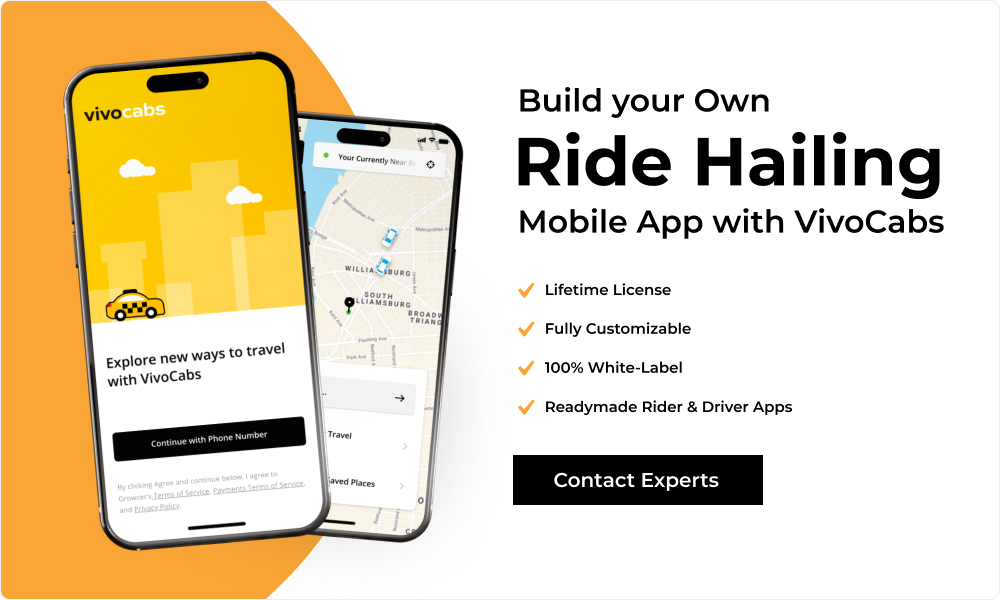
VivoCabs is a complete ride-booking software designed specifically for independent and regional taxi operators who are ready to scale, without losing the customer relationships and local trust they’ve spent years building. It helps traditional operators modernize their business model without sacrificing the customer trust, local reputation, and driver network they have built over the years.
Instead of relying on manual bookings, phone-based dispatch, and disconnected operations, VivoCabs gives you a centralized digital platform to manage bookings, drivers, payments, and business performance from one place. Whether you operate a small fleet or are planning multi-city expansion, the solution is designed to support long-term growth with greater operational control.
What you get with VivoCabs:
- Your own branded driver & rider apps, your name, your identity
- Real-time GPS fleet visibility across all drivers
- UPI & digital payments built in with zero setup
- Driver performance analytics and ratings dashboard
- 24/7 online booking, no missed rides while you sleep
- Zero per-ride commission cuts, keep 100% of your revenue
- Guided onboarding support designed for non-technical operators
- Scalable architecture for growing fleets and higher ride volume
- Centralized admin panel for complete operational oversight
Explore How VivoCabs Can Scale Your Taxi Business
Conclusion
The businesses that succeed in the taxi industry are not the ones with the most drivers or the longest history. But the one who combines local knowledge and trusted customer relationships, the genuine advantages of an independent operator, with the operational efficiency and data intelligence that only a digital platform can provide.
Your local expertise is irreplaceable. Your driver relationships are a real competitive asset. Your community reputation is something no national app can replicate overnight. But all of those advantages are being neutralised by operational friction that keeps your business from growing the way it should.
“Scaling a taxi business isn’t about working more. It’s about building infrastructure that works while you don’t.”
The hidden reason your taxi business cannot scale is not your city, not your competition, not the economy, and not your drivers. It’s the operating system you’re running on, and that is the one thing you have the power to change.
Ready to Replace Outdated Systems and Scale Your Taxi Business?
Contact UsPopular Posts