The year 2026 marks a pivotal era in urban mobility with a lucrative CAGR of 7.62%, driven by an accelerated urban population that prefers digital-first and convenience-driven solutions for fulfilling their mobility requirements. The industry is witnessing high growth, with the taxi market size expected to reach USD 366.91 billion in 2031. The fragmented industry is now in the process of being transformed into an organised sector.
Therefore, times have transformed to offer enhanced convenience, and gone are the days when a simple “point A to point B” app was enough to compete. Today, the demand for super apps has accelerated towards the taxi industry, which is a sophisticated ecosystem driven by Artificial Intelligence (AI), Electric Vehicle (EV) integration, and a shift toward “Mobility-as-a-Service” (MaaS).
Whether you are an aspiring entrepreneur or an established fleet owner, launching a taxi booking app in 2026 is the right time for investment, and the launch requires more than just code; it requires a strategic fusion of technology, user-centric design, and hyper-local marketing. This guide provides the definitive blueprint for navigating this proliferating global market.
Table of Contents
What is a Taxi Booking App & How it Works?
A taxi booking app is a digital platform that connects passengers in need of a ride-hailing taxi with available drivers via mobile devices. In 2026, these ride-hailing apps function as sophisticated dispatch engines that manage supply and demand in real-time.
How it Differs from Traditional Taxi Services?
While the traditional services rely on physical presence or phone calls, often leading to long wait times and unpredictable pricing. App-based services offer. Furthermore, to give a better idea of the ride-hailing app services and the traditional taxi booking system, given below are the differentiating elements.
1. Pre-determined Pricing: With a robust taxi booking app, consumers do not experience meter anxiety, long hauling, vague pricing, and cash-only limitations. The pain points encountered by the users are now resolved.
2. Safety Accountability: The taxi booking app presents the digital trails of every ride. While the traditional taxis are considered safe, with vetted background checks, the taxi-hailing business is also catching up in terms of safety accountability.
3. Operational Efficiency: The taxi booking apps have increased real-time tracking, ride allotment, and integrated online payment processes, and overall reduced the dead mileage by leveraging AI algorithms to ensure the closest driver is dispatched.
Working Model of a Taxi Booking App
The operational workflow of a taxi booking app is designed to ensure speed, efficiency, and convenience for both users and drivers.
1. User Requests a Ride
The initiation occurs when the user enters their pickup and drop-off locations in the app. Based on this, the platform calculates an estimated fare and shows the available ride options. This step ensures users add their pickup, drop-off, and desired vehicle type before confirming the booking.
2. Driver Assignment
The driver is assigned once the booking is confirmed; the app identifies nearby available drivers and automatically sends an alert about the ride request, and the nearest available driver can either accept or decline the request.
For an advanced algorithms assignment, these parameters are determined, which assists in reducing wait time and improving ride efficiency.
- Driver proximity
- Driver Availability
- Acceptance rate
- Traffic conditions
3. Ride Tracking & Execution
After the driver accepts the ride, the passenger gets the details of the driver, and the user can track their location in real time as an advanced ride-hailing app ensures the following parameters are met during the trip, as it enhances both safety and user experience.
- GPS tracking ensures route transparency
- Navigation systems suggest optimal routes
- Users receive live updates on ride progress
4. Trip Completion
Once the driver arrives at the location, the passenger receives an OTP and the driver’s details before initiating the ride. The system calculates the final fare based on distance traveled, time taken, surge pricing, and more. Once the ride is completed, the driver marks the ride as complete and collects the payment. Users are then prompted to rate the driver and provide feedback.
5. Payment Processing
The app supports multiple payment methods, making transactions seamless. These payment methods are UPI, cards, wallets, cash payments, and automatic invoice generation. A smooth and secure payment process ensures a hassle-free payment experience.
This is a sought-after, traditional workflow that is followed in a taxi booking app. A robust and powerful ride-hailing software enables easy taxi booking through the app. A business owner can leverage the benefits of a taxi booking app, as will be discussed in the blog, and its high-quality features, some of which are listed below.
Key Features of a Taxi Booking App
A taxi-booking app offers full-fledged app functionalities that provide an overall consumer-centric experience paired with a smooth workflow handling three critical pillars.
- Seamless User Registration and Profile Management
- Real-time GPS & Precise Tracking and Navigation
- Smart Ride Booking Options
- In-App Automated Payments
- Digital and Transparent Pricing
- Safety and Security Features
- Driver App Features
- Push Notifications and Alerts
- Route Optimization & Analytics
- Admin Dashboard Analytics
These key features dictate the overall workflow of a taxi booking app. The blog talks about these features in detail in the later part. A taxi booking app is fully equipped with features for every user type that enhance the overall user experience.
Experience End-to-End Functionalities of the Best Ride-hailing Software!
Convenience is king, and therefore users in 2026 value the ability to schedule rides in advance, see their driver’s rating, and share their live location with loved ones—all from a single interface. Next, the blog discusses the steps to launch a foresight taxi booking app.
Step-by-Step Guide to Launch a Powerful Taxi Booking App
Launching a taxi booking app has become a seamless procedure with the present-day digital transformation. An aspiring entrepreneur looking to launch a multi-vendor aggregator taxi booking app, or an existing taxi business owner interested in expanding their services by launching a single vendor business app, can all seamlessly leverage the benefits of app-enabled transportation.
Step 1: Define Business Model & Target Audience
Before moving into development, it’s essential to build a clear strategic foundation for your taxi booking app. This step is not just about making instant decisions, but curating strategic mapping that directly influences your operational structure, cost model, scalability, and long-term profitability of your taxi booking app.
Therefore, a well-defined business model helps you understand how your platform will function, while a clearly identified target audience ensures that your features, pricing, and marketing efforts are aligned with real user needs. However, with an unfit strategy, even if your taxi booking app is technically strong, it may struggle to gain traction in a competitive market.
a. Choose the Right Business Model
The first step in the market analysis is to find and select the right business model. Therefore, start by selecting the one that best fits your resources and long-term vision.
1. Aggregator Taxi Booking App Model: This business model connects riders with independent drivers and earns commission per ride. This is asset-light and ideal for rapid scaling.
2. Fleet Owner Taxi Booking App Model: The business owner own and manage vehicles and drivers, giving you full control over operations and service quality, but requiring higher investment if you are not an existing business.
3. Hybrid Taxi Booking App Model: This is the combination of both, allowing you to balance app scalability with operational control.
By determining your target audience and business model, the choice here will also define revenue generation, driver management, and expand services across locations.
b. Identify Your Target Audience
Understanding your target audience is critical to build a product that solves real problems for different user segments and realises diverse customer expectations and usage patterns.
1. Daily commuters: If your target audience is daily commuters, such as residents and school students, focus on affordability, quick availability, and reliability
2. Corporate users: If the commuters are corporate users, your taxi-booking app requires punctuality, scheduled rides, and professional services.
3. Tourists & travelers: If your ride-hailing business is in the tourist and traveler industry, prefer flexible bookings, easy navigation, and comfort.
4. Airport travelers: An upcoming niche of airport travelers requires pre-scheduled, dependable rides with minimal delays.
Henceforth, by clearly defining your audience, you can tailor features, pricing models, and marketing strategies more effectively.
c. Define Your Unique Selling Proposition (USP)
Next, it is an essential step to define your USP early in the industry. In a market with multiple taxi apps, having a clear differentiator is crucial. Your USP is what sets your platform apart and gives users a reason to choose you over competitors. Some of the sought-after unique-value points can be,
1. Lower commission or pricing advantage
2. Faster driver allocation and reduced wait times
3. Niche services (e.g., EV-only rides, women drivers, corporate-focused solutions)
4. Superior user experience or localized features
To enunciate, your USP should address a specific gap in the market and be consistently reflected across your product and marketing.
Step 2: Choose the Right Features
The success of your taxi booking app largely depends on how well it solves real user problems and delivers a seamless experience across all stakeholders. Therefore, simply adding basic functionalities is not enough, a business owner must add features designed to improve convenience, efficiency, and trust for riders, drivers, and admins.
Integrate your taxi booking app with well-balanced feature set to ensure smooth operations, higher user satisfaction, and better retention. Furthermore, it also plays a crucial role in differentiating your platform in a competitive market. Hence, by focusing on the right features from the start, you can create a strong foundation for long-term growth and scalability.
Rider-focused Features
Rider-side features directly impact user experience and are often the key factor in whether users continue using your platform.
1. Easy Ride Booking
This is the core functionality of your app. Users should be able to book a ride within a few taps without any confusion or delays. Easy ride booking features allow a frictionless booking experience, increase conversions, and reduce drop-offs.
a. Simple and intuitive interface
b. Quick location detection (GPS/manual input)
c. Minimal steps to confirm booking
2. Real-Time Tracking
Real-time tracking enhances transparency and builds trust by allowing users to monitor their ride at every stage. The listed features are essential for improving both user confidence and safety.
a. Track driver location before pickup
b. View live route and trip progress
c. Share ride details for safety
3. Fare Estimation
A powerful taxi booking app provides fare estimates before booking, helping users make informed decisions and avoiding pricing disputes as transparent pricing significantly improves user satisfaction.
a. Displays approximate trip cost upfront
b. Breaks down base fare, distance, and time
c. Shows surge pricing (if applicable)
4. Multiple Payment Options
A flexible payment system ensures convenience for a wide range of users. Your taxi booking app must integrate the given features, along with offering multiple payment choices reduces friction at the final stage of the ride.
a. Supports UPI, debit/credit cards, and wallets
b. Option for cash payments
c. Secure and fast transactions
5. Ride Scheduling
This feature allows users to book rides in advance for planned trips. The ride scheduling feature in your taxi booking app adds convenience and reliability for users with planned travel needs.
a. Schedule rides for a specific date and time
b. Ideal for airport transfers and meetings
c. Ensures availability during peak hours
Driver- focused Features
The driver-side features are also of great importance in enhancing the user experience, as they directly impact user satisfaction with driver retention, and overall supply on your platform.
1. Ride Request Management
Drivers should have full visibility and control over incoming ride requests. Consequently, this improves driver experience and ensures better trip acceptance rates.
a. View trip details before accepting
b. Accept or reject requests
c. Reduces unwanted or inconvenient trips
2. Earnings Dashboard
A transparent payment and platform earnings system helps build trust and motivates drivers to stay active, and these clear insights into earnings encourage long-term driver engagement. Therefore, it is suggested to integrate the given features.
a. Track daily, weekly, and monthly income
b. View completed trips and incentives
c. Monitor deductions and commissions
3. Navigation Support
Efficient navigation support is critical for completing trips quickly and accurately, as it assists drivers in saving time, reduce fuel costs, and improve ride efficiency. It is recommended for a business owner to invest in a ride-hailing software that provides robust features such as
a. Built-in GPS navigation
b. Traffic-aware route suggestions
c. Turn-by-turn directions
4. Availability Toggle
The availability toggle is a necessary feature that allows drivers to control their working hours when they want to work. This flexibility improves driver satisfaction and platform reliability.
a. Go online/offline anytime
b. Manage work schedule independently
c. Avoid unnecessary ride requests
Admin-focused Features
The admin panel is an essential user dashboard to control your taxi booking app operations, enabling you to manage operations, monitor performance, and scale efficiently.
1. User & Driver Management
This feature allows you to control and manage all platform users. Additionally, the user management feature ensures platform safety and quality control.
a. Approve/reject driver registrations
b. Verify documents and profiles
c. Handle disputes and support requests
2. Commission Setup
A flexible commission management system helps you manage revenue effectively, which allows better financial control and scalability of your taxi booking app.
a. Set percentage-based or fixed commissions
b. Configure city-wise or service-wise rates
c. Adjust commissions dynamically
3. Pricing Control
Admins should have full control over revenue models and revenue structures. A business owner must integrate fair pricing models; therefore, they can introduce dynamic pricing, which helps balance demand and maximize revenue.
a. Define base fares, per km, and per minute charges
b. Enable surge pricing during peak hours
c. Customize pricing for different locations
4. Analytics Dashboard
The analytics dashboard determines that the taxi app business owner makes data-driven insights to make informed business decisions. This feature helps optimize operations and improve overall platform efficiency, and includes the following,
a. Track bookings, revenue, and growth trends
b. Analyze user behavior and peak hours
c. Monitor driver performance
Invest in High-Value Features for Your Taxi Booking App!
Step 3: Finalize Revenue Channels
A well-defined monetization strategy is essential for building a sustainable and profitable taxi booking business. While launching the app is important, long-term success depends on how effectively you generate and diversify your revenue streams.
A taxi booking app owner cannot rely on a single source of income as it can limit growth, whereas a combination of multiple revenue channels ensures stability, scalability, and consistent cash flow even during fluctuations in demand. Henceforth, by strategically aligning your revenue model with user behavior and market demand, you can maximize profitability while maintaining a competitive pricing structure.
1. Commission Per Ride
This is the most common and reliable revenue model used by taxi booking platforms. The platform charges a fixed percentage or flat fee from every completed ride. Consequently, as your number of bookings increases, your revenue grows proportionally, making it a strong foundation for your business model.
a. Directly linked to ride volume, ensuring scalable revenue
b. Works well with aggregator and hybrid models
c. Easy to implement and manage
2. Driver Subscription Plans
In this model, drivers pay a recurring fee (weekly or monthly) to access the platform or unlock premium benefits. The subscription packages are especially useful during low-demand periods, as it ensures a steady income regardless of ride volume.
a. Offers features like reduced commission or priority bookings
b. Provides predictable and recurring revenue
c. Helps retain active and serious drivers
3. Surge Pricing
Surge pricing allows you to increase fares during periods of high demand, such as peak hours, bad weather, or special events. Therefore, when implemented correctly, the surge pricing improves both platform efficiency and profitability.
a. Balances demand and supply by incentivizing more drivers to go online
b. Maximizes revenue during high-demand situations
c. Encourages faster ride availability for users
4. Corporate Partnerships
Partnering with businesses and organizations can unlock a consistent and high-volume revenue stream. Business owners must incoopertae these tie-ups as it not only generate stable income but also help in building brand credibility and long-term business relationships.
a. Offer transportation solutions for employees
b. Secure long-term contracts and bulk bookings
c. Reduce dependency on individual riders
Step 4: Development Approach
Choosing the right development approach is a critical decision that directly impacts your time-to-market, investment, and overall business success. In a competitive industry like ride-hailing, speed and efficiency often play a more important role than building everything from scratch.
Businesses today are increasingly prioritizing faster launches, lower risk, and proven technology, making the choice between custom development and readymade software more important than ever.
While both approaches have their place, the key is to select the one that aligns best with your resources, timelines, and go-to-market strategy.
1. Custom Development
Custom development involves building your taxi booking app from scratch, tailored to your specific business requirements. While it offers flexibility, it also comes with significant challenges that can slow down your launch and increase overall risk.
Pros
a. Custom-built according to your specific requirements
b. Allows some level of feature differentiation
Cons
a. High development cost, including design, development, and testing
b. Long development timeline (often several months)
c. Requires a dedicated technical team for development and ongoing maintenance
d. Higher risk of delays and budget overruns
e. Continuous effort needed for updates, bug fixes, and scaling
f. Slower time-to-market, which can result in missed opportunities
2. Readymade Software
On the other hand, readymade software provides a complete, pre-built solution that includes all essential features required to launch a taxi booking platform. It is designed to help businesses go live quickly, reduce technical complexity, and focus on growth rather than development.
This approach is becoming the preferred choice for startups and growing businesses looking to enter the market efficiently and competitively.
Pros
a. Rapid deployment—launch your platform in weeks instead of months
b. Significantly lower upfront investment compared to custom development
c. Comes with pre-tested, reliable, and industry-proven features
d. Eliminates the need for a large in-house technical team
e. Faster time-to-market, helping you capture early users and revenue
f. Scalable architecture to support future growth
g. Continuous updates and improvements from the provider
h. Allows you to focus on operations, marketing, and scaling instead of development
Cons
a. Limited customization for highly specific or niche requirements
b. Dependency on the provider for major upgrades
Looking for an All-rounded Readymade Software for your Business?
Step 5: How to Launch & Market Your App
Launching your app is just the first milestone, while the real success depends on how effectively you attract users, drive installs, and convert them into active customers. A well-planned marketing strategy not only helps you gain initial traction but also builds long-term brand visibility and trust in your target market.
To grow your platform sustainably, it’s important to combine paid acquisition with organic strategies and user-driven growth.
1. App Install Campaigns
A business owner can run targeted paid campaigns on platforms like:
a. Google Ads
b. Meta Ads (Facebook & Instagram)
These platforms allow you to reach users who are either actively searching for ride services or fall within your ideal target audience.
For a competitive edge in the industry focus on the following marketing measures.
a. Cost per install (CPI): Continuously optimize campaigns to reduce user acquisition costs while maintaining quality installs
b. Geo-targeting: Focus on specific cities, high-demand areas, or launch regions to improve conversion rates and relevance
c. App Store Optimization (ASO): Optimize app titles, descriptions, keywords, and visuals to improve visibility and organic installs
2. Local SEO Optimization
Local SEO helps you attract users who are searching for taxi services within your operating area. It has been established over time that a strong local presence can drive consistent, high-intent traffic without ongoing ad spend.
a. Optimize your website for location-based keywords.
b. Create and regularly update your Google Business Profile
c. Build local backlinks and listings to improve your search rankings
3. Referral Programs
Referral marketing is one of the most cost-effective and scalable ways to grow your user base. This not only reduces acquisition costs but also builds trust, as users are more likely to try services recommended by people they know. These are the ways it enhances your name in the industry.
a. It encourages existing users to invite friends and family
b. Offer incentives such as discounts, ride credits, or cashback for both referrer and referee
Why Choose VivoCabs for your Taxi Booking App Deployment?
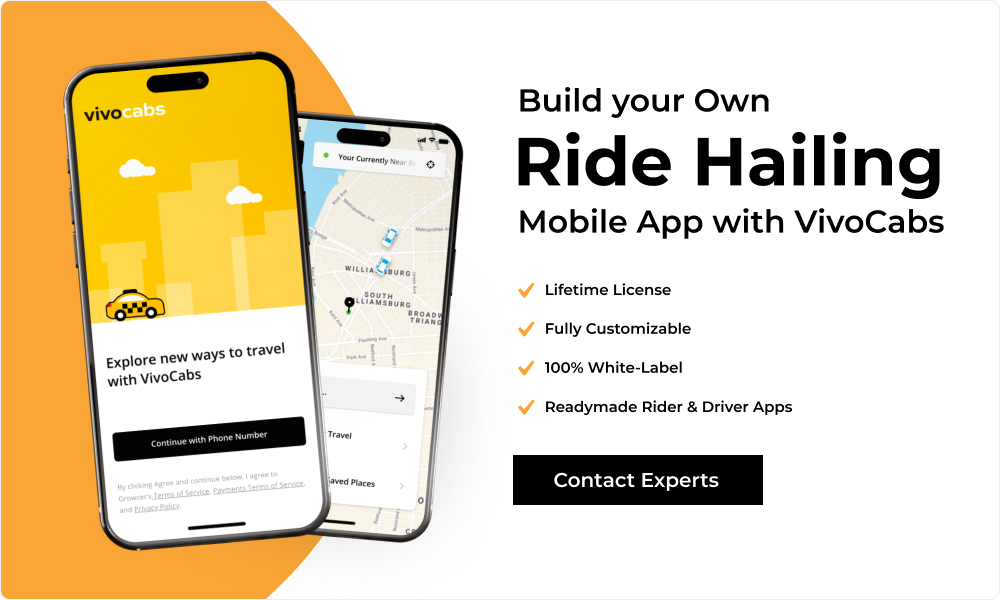
Launching a taxi booking app from scratch can be time-consuming, expensive, and technically complex. This is where a ready-made solution like VivoCabs makes a significant difference.
VivoCabs is designed to help businesses quickly launch, manage, and scale their ride-hailing platform without dealing with the challenges of custom development. Instead of spending months building features, you get a complete, business-ready solution that allows you to enter the market faster and start generating revenue sooner.
It comes equipped with all the essential components required to run a successful taxi booking business, including:
a. Dedicated rider and driver mobile apps for seamless booking and trip management
b. Advanced admin dashboard to control operations, users, pricing, and commissions
c. Real-time tracking system for live ride monitoring and improved transparency
d. Scalable architecture to support growth as your user base expands
What sets VivoCabs apart is that it doesn’t just offer software but it provides a ready-to-launch ecosystem on a versatile architecture that reduces complexity and accelerates your business journey.
Key Benefits
a. Faster time-to-market: Launch your taxi app in weeks instead of months
b. Lower development cost: Avoid heavy upfront investment and technical expenses
c. Proven business model: Built on industry-tested features and workflows
d. Easy scalability: Expand to new cities and users without technical limitations
e. Focus on growth: Spend more time on marketing, operations, and scaling rather than development
Get Hands-on Experience of the Software with a Free Personalised Demo
Conclusion
Launching a taxi booking app in 2026 is no longer just about entering the mobility market—it’s about building a technology-driven, scalable, and user-centric ecosystem. With evolving customer expectations, AI-driven operations, and increasing competition, success depends on how well you combine strategy, technology, and execution.
From defining the right business model and selecting essential features to finalizing revenue streams and choosing the right development approach, each step plays a critical role in shaping your platform’s growth and profitability. Therefore, businesses that focus on speed-to-market, operational efficiency, and seamless user experience are more likely to gain a competitive edge.
FAQs
Q 1. How much does it cost to build a taxi booking app?
Ans. The cost depends on your development approach- readymade or custom development method. Custom development can be expensive due to design, development, and maintenance costs, while readymade solutions like VivoCabs offer a more cost-effective alternative with faster deployment.
Q 2. How long does it take to launch a taxi booking app?
Ans. With custom development, it can take several months to build and launch a fully functional app. However, with a ready-made solution like VivoCabs, you can launch your platform within a few weeks.
Q 3. What features are essential for a taxi booking app?
Ans. Essential features include ride booking, real-time tracking, fare estimation, multiple payment options, driver management, and an admin dashboard for operational control.
Q 4. How do taxi booking apps make money?
Ans. Taxi apps generate revenue through multiple channels such as commission per ride, driver subscription plans, surge pricing, and corporate partnerships.
Q 5. Is it better to build a taxi app from scratch or use readymade software?
Ans. While custom development offers flexibility, it is time-consuming and costly. Readymade software like VivoCabs is a more practical choice for faster launch, lower cost, and proven features.
Launch a Success-oriented Taxi Booking App with VivoCabs!
Get Started TodayPopular Posts