

Published Date 25th Aug, 2026
TL; DR:
| Rank | Ride-Hailing Software | Best Suited For | Key Differentiator |
|---|---|---|---|
| 1 | VivoCabs | Startups, entrepreneurs & established mobility businesses | Self-hosted lifetime license & customizable source code |
| 2 | Onde | Startups and growing ride-hailing operators | Established SaaS-based white-label ecosystem |
| 3 | Yelowsoft | Taxi fleets and transportation operators | Extensive dispatch and fleet management capabilities |
| 4 | TaxiCaller | Taxi, limo & private-hire fleets | Cloud-based dispatch and flexible fleet pricing |
| 5 | iCabbi | Established taxi and private-hire fleets | Highly configurable dispatch technology |
| 6 | Autocab | Established taxi operators | Booking, dispatch and demand-network capabilities |
| 7 | Jugnoo | Multi-service mobility businesses | No-code Mobility-as-a-Service platform |
| 8 | ATOM Mobility | Mobility startups and multi-modal operators | Ride-hailing, rental and vehicle-sharing ecosystem |
The ride-hailing industry continues to evolve as consumers increasingly expect convenient, app-based transportation services. While global platforms have transformed urban mobility, opportunities continue to emerge for regional taxi companies, transportation operators, and entrepreneurs to launch ride-hailing services tailored to specific markets.
However, building the technology behind a ride-hailing platform is complex. A complete ecosystem may require rider and driver applications, real-time location tracking, automated ride allocation, fare calculation, payment processing, fleet management, analytics, safety features, and administrative controls. Developing all these capabilities from scratch can require considerable time, technical resources, and investment.
This is where ride-hailing software becomes valuable. Modern ride-hailing software provides businesses with ready-made technology to digitize existing taxi operations or launch entirely new mobility platforms. Depending on the provider, businesses can access white-label mobile applications, dispatch technology, fleet management capabilities, payment integrations, analytics, and other operational tools.
To help entrepreneurs and transportation businesses evaluate their options, we have compiled some of the best ride-hailing software solutions to consider in 2026-27.
Table of Contents
What is Ride-Hailing Software?
Ride-hailing software is a technology platform that enables businesses to operate app-based transportation services where customers can request rides and get connected with available drivers.
Unlike a basic taxi booking application, modern ride-hailing software typically combines multiple interconnected tools to manage the entire ride-booking and fulfillment process. These may include:
- Rider mobile applications
- Driver mobile applications
- Administrative dashboard
- Automated ride assignment
- Real-time driver tracking
- Fare management
- Multiple vehicle categories
- Payment gateway integrations
- Driver management
- Ratings and reviews
- Notifications
- Promotional campaigns
- Reporting and analytics
- Geolocation and mapping integrations
Advanced solutions may also support additional mobility services and use cases, such as parcel delivery, rental rides, scheduled rides, corporate transportation, multi-city operations, multiple payment methods, and other mobility models.
For businesses, ready-made ride-hailing software can reduce the technological complexity of launching and managing a mobility platform. It provides a pre-built foundation that businesses can customize according to their operational requirements and market needs.
Best Ride-Hailing Software Solutions in 2026-27
1. VivoCabs
Best For: Entrepreneurs, taxi businesses, mobility startups, and enterprises looking for a fully customizable, self-hosted ride-hailing platform.
Deployment Model: Self-hosted
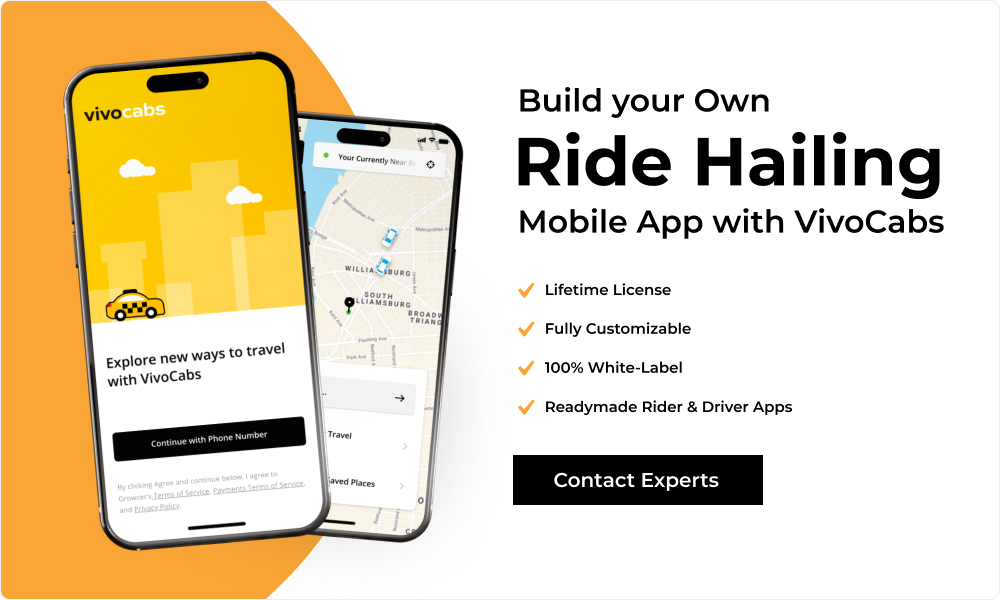
VivoCabs is a white-label ride-hailing software designed to help entrepreneurs and transportation companies launch their own branded ride-hailing platforms. It provides the core technology required to manage rider bookings, driver operations, payments, tracking, and other day-to-day operations.
Unlike many SaaS solutions where businesses continue paying monthly or per-ride platform fees, VivoCabs follows a lifetime licensing model. Businesses can deploy the software on their preferred server infrastructure and operate their mobility platform with greater control over technology and data.
The platform provides rider and driver applications for Android and iOS alongside a web landing page and comprehensive administrative capabilities. Additionally, its 100% white-label setup allows businesses to build a distinct brand identity across customer-facing applications and interfaces.
Another key differentiator is customizable source code. Businesses that require deeper customization can opt for it and modify the platform to accommodate specific operational requirements, integrations, or business models.
Key Features of VivoCabs
- Rider Application
The rider app allows customers to register, select vehicle categories, enter pickup and destination locations, estimate fares, request rides, track drivers, make payments, view ride history, and rate their experience.
- Driver Application
The driver app enables drivers to receive ride requests, manage their availability, navigate to pickup locations, track earnings, manage documents, and access relevant ride information.
- Real-Time Tracking
GPS-powered tracking allows riders to monitor their driver’s location while giving operators greater visibility into active rides and ongoing operations.
- Flexible Fare Management
Businesses can configure fare structures based on their operational requirements, providing greater flexibility than platforms with fixed pricing models.
- Multiple Payment Options
The platform supports integration with multiple payment gateways, allowing businesses to offer suitable payment methods across different markets.
- White-Label Branding
Businesses can apply their own branding across the rider app, driver app, website, and other customer-facing components, creating a consistent brand experience.
- Multi-City Scalability
Businesses can expand their ride-hailing operations across multiple geographical locations as they grow.
VivoCabs V5 also introduces capabilities such as parcel booking, ETA and route preview, and enhanced payment flexibility.
Why VivoCabs Ranks #1
VivoCabs stands out in this comparison for combining self-hosting, white-label branding, lifetime licensing, customization, and customizable source code in a single ride-hailing solution.
Many ride-hailing platforms use SaaS pricing models, which can offer a lower initial commitment but involve recurring costs as the business grows. VivoCabs follows a lifetime licensing approach and states that it does not charge recurring software licensing fees.
Its self-hosted deployment model also gives businesses greater control over their infrastructure and technology. For entrepreneurs and mobility businesses that prioritize ownership, customization, and long-term control, these factors make VivoCabs a strong option.
Want to Learn How VivoCabs Can Work For Your Business?
2. Onde
Best For: Startups and taxi companies seeking a SaaS-based, white-label ride-hailing ecosystem.
Onde is an established mobility technology provider offering white-label applications and operational tools for taxi and ride-hailing businesses. Its ecosystem includes customer and driver applications, web applications, a dispatch system, and administrative tools, allowing businesses to launch or scale ride-hailing operations without developing the underlying platform from scratch.
The customer applications are available for iOS and Android and can be branded to match the operator’s identity. Onde also supports multiple languages and locations, making it suitable for businesses operating internationally.
Key Features
- White-label customer app
- Driver application
- Web booking application
- Dispatch system
- Administrative tools
- In-app communication
- Fleet management
- Business analytics
- Multiple language support
- Multi-service expansion capabilities
Onde is particularly suited to entrepreneurs who prefer a SaaS model, with the technology provider handling much of the infrastructure and ongoing platform maintenance. The trade-off is reduced control over the underlying technology, as businesses remain dependent on the provider’s ecosystem rather than independently hosting and managing the complete platform.
Suggested Read: VivoCabs Vs Onde App: Make the Right Choice for Your Ride-Hailing Business
3. Yelowsoft
Best For: Taxi fleets requiring advanced booking, dispatch, driver management, and operational automation.
Yelowsoft provides taxi dispatch and fleet management technology designed for transportation companies looking to automate day-to-day operations. The platform offers multiple booking channels, including applications, web-based bookings, email, WhatsApp, bookings, recurring ride scheduling, and manually created bookings.
One of Yelowsoft’s key strengths is its dispatch technology. Its automated dispatch system can allocate rides based on factors such as driver location, availability, vehicle requirements, and configured operational rules, while businesses can retain manual control when needed.
Key Features
- Automated dispatch
- Manual ride allocation
- Real-time driver tracking
- Demand heatmaps
- Ride broadcasting
- Advanced ride scheduling
- Driver management
- Vehicle management
- Corporate transportation capabilities
- Multiple pricing models
- Payment management
- Reporting and analytics
- SOS and passenger safety features
Yelowsoft also supports distance-based, fixed, zone-based, and surge pricing. Its combination of booking, dispatch, reporting, and fleet management makes it particularly relevant for established transportation businesses looking to digitize and automate traditional operations.
4. TaxiCaller
Best For: Small-to-medium taxi, limousine, private-hire, shuttle, and specialized transportation fleets.
TaxiCaller is a cloud-based taxi dispatch solution that has been operating since 2011 and states that its technology is used by transportation businesses in more than 70 countries. Its software is primarily focused on helping transportation operators digitize booking, dispatch, driver management, and fleet operations.
Customers can book through multiple channels, while operators can manage vehicles and jobs using a centralized dispatch environment.
Key Features
- Cloud-based dispatch
- Automated job distribution
- Passenger application
- Driver application
- Real-time vehicle tracking
- Web booking
- Corporate booking
- Trip scheduling
- Route optimization
- Reporting and analytics
- Job history
- Reception booking tools
TaxiCaller offers pricing based on the number of active vehicles, making it attractive for smaller operators seeking predictable software expenses. However, businesses requiring extensive source-code customization or complete technology ownership should assess whether a cloud-based subscription model aligns with their long-term strategy.
5. iCabbi
Best For: Established taxi and private-hire fleets requiring sophisticated dispatch configuration.
iCabbi provides taxi dispatch technology focused heavily on fleet operations, intelligent ride distribution, booking management, and operational automation. Its dispatch engine can handle straightforward point-to-point trips as well as recurring journeys and bookings involving multiple pickup and drop-off locations.
One of iCabbi’s strongest capabilities is its highly configurable dispatch environment. Businesses can create dispatch rules according to location, time, fleet, zones, demand patterns, and other operational requirements.
Key Features
- Intelligent taxi dispatch
- Flexible dispatch rules
- Dispatch by ETA
- Zone management
- Multi-fleet management
- Overbooking management
- Driver applications
- Passenger applications
- Fixed fares and tariffs
- Automated workflows
- Flight tracking
- Reporting and operational data
iCabbi also supports real-time traffic-aware ETA capabilities through Google Fleet Engine integration. This makes the platform particularly suitable for established taxi businesses where dispatch efficiency and operational configuration are more important than simply launching an Uber-style consumer application.
6. Autocab
Best For: Established taxi and private-hire businesses focused on booking automation and demand management.
Autocab is a long-established technology provider serving taxi and private-hire businesses. Its booking and dispatch software helps operators manage trips, automate operational workflows, optimize driver utilization, and handle fluctuating passenger demand.
Autocab states that its booking and dispatch technology is used by customers across 33 countries, supporting transportation businesses looking to improve operational efficiency and manage bookings at scale.
Key Capabilities
- Taxi booking management
- Automated dispatch
- Demand management
- Fleet optimization
- Driver management
- Passenger booking tools
- Business automation
- Trip aggregation
- Operational reporting
A notable part of the Autocab ecosystem is its iGo marketplace, which connects taxi companies with additional demand sources and trip aggregators. This can help established operators combine their internal booking operations with external demand channels.
Autocab therefore fits particularly well within established taxi markets where operators already have fleets and customers but need stronger technology to improve efficiency and compete with app-based transportation platforms.
7. Jugnoo
Best For: Businesses planning multi-service mobility platforms beyond standard taxi booking.
Jugnoo provides a broader Mobility-as-a-Service platform rather than focusing exclusively on taxi dispatch. The platform can support different transportation models including taxi services, airport transfers, ridesharing, carpooling, vehicle rental, and multi-service mobility marketplaces.
Jugnoo positions its technology as a no-code platform that enables entrepreneurs to launch branded transportation applications without building the entire technology stack independently.
Key Features
- White-label applications
- Automated dispatch
- Dynamic pricing
- Rider management
- Driver management
- Real-time fleet tracking
- Promotions and discounts
- Analytics and reports
- Ride booking kiosks
- Multiple payment options
- Multi-service mobility support
Its broader mobility ecosystem makes Jugnoo especially interesting for entrepreneurs planning to move beyond a single transportation service. For example, a business could potentially combine taxi booking with airport transfers, ridesharing, rentals, or other on-demand services.
Turn Your Ride-Hailing Idea Into A Market-Ready Platform
8. ATOM Mobility
Best For: Mobility startups interested in combining ride-hailing with vehicle sharing and digital rental services.
ATOM Mobility provides technology for ride-hailing businesses as well as vehicle-sharing and digital-rental operators. Its ride-hailing product includes branded rider applications, driver applications, automated dispatch capabilities, payments, analytics, fleet-management tools, and an administrative dashboard.
The company states that businesses can launch a ride-hailing platform using its technology in approximately 20 days.
Key Features
- Branded rider applications
- Driver applications
- Automated ride dispatch
- Real-time ride and driver information
- Fleet management
- Zones and geofencing
- Heatmaps
- Analytics
- Multiple payment integrations
- Marketing tools
- Open API and third-party integrations
ATOM Mobility’s most interesting differentiator is its broader mobility ecosystem. Businesses can combine ride-hailing with vehicle sharing and digital rental services, potentially creating a multi-service mobility application from the same technology provider.
How to Choose the Best Ride-Hailing Software?
The “best” ride-hailing software is not necessarily the one with the longest feature list. Businesses should evaluate solutions based on their operating model, target market, growth plans, and technology strategy. Key factors include customization, user experience, ride allocation, scalability, ownership, and the level of control the software provides.
Here are some of the most important factors to consider:
1. White-Label Capabilities
Your ride-hailing platform should represent your business, not the software provider.
Evaluate whether you can customize:
- Business name
- Logo
- Colors
- Mobile applications
- Domain
- Customer communication
- User interface
Strong white-label capabilities help establish brand identity while delivering a consistent customer experience across every touchpoint.
2. Rider and Driver Experience
A successful ride-hailing platform must deliver a seamless experience for both riders and drivers. Riders expect fast bookings, accurate ETAs, transparent fares, convenient payments, real-time tracking, and reliable communication.
Drivers need intuitive ride management, navigation, earnings visibility, availability controls, and simple workflows to manage their daily operations efficiently.
3. Ride Allocation
Ride allocation directly influences waiting times and driver utilization. Look for software capable of intelligently connecting riders with suitable nearby drivers while handling cancellations, unavailable drivers, scheduled rides, and changing demand.
Research into large-scale ride-sharing systems also highlights how intelligent dispatch and demand prediction can contribute to lower passenger waiting times and better fleet utilization.
4. Customization
Transportation businesses operate differently across markets, making customization essential. Consider whether the software can accommodate different vehicle types, payment methods, regulations, fare structures, taxes, driver commissions, and user requirements.
Flexible customization allows businesses to adapt the platform to local market conditions while supporting expansion into new cities or regions.
5. Scalability
Your technology should be capable of growing with your business. A platform handling hundreds of rides today may eventually process hundreds of thousands across multiple locations.
Evaluate whether your technology can accommodate growth across:
- Users
- Drivers
- Transactions
- Cities
- Service categories
- Payment methods
Choosing scalable technology early can help avoid costly and disruptive migrations later.
6. SaaS vs Self-Hosted Software
Choosing between SaaS and self-hosted software depends on your long-term technology strategy. SaaS solutions generally require lower technical involvement. The vendor manages infrastructure and software maintenance while the business pays recurring fees.
Self-hosted solutions provide greater infrastructure control and can offer stronger customization and ownership opportunities, although the operator assumes greater responsibility for hosting and technical management. Businesses should consider their long-term technology strategy rather than comparing only the initial purchase price.
Why Ready-Made Ride-Hailing Software Makes Sense in 2026-27
Building a sophisticated ride-hailing ecosystem entirely from scratch can be resource-intensive. Businesses must develop and synchronize multiple components, including rider apps, driver apps, location services, payment workflows, administrative systems, notifications, security, APIs, and analytics. The platform also requires continuous maintenance, updates, and improvements after launch.
Ready-made ride-hailing software provides an established foundation where the essential functionality already exists. This allows businesses to reduce development effort and focus more resources on growth-driving activities such as:
- Driver acquisition
- Rider acquisition
- Local partnerships
- Marketing
- Customer service
- Regulatory compliance
- Pricing strategy
- Geographic expansion
For startups, a shorter development cycle can also enable faster market validation. Businesses can test their concept, gather user feedback, and refine their operations before making significant investments in extensive custom technology development.
Reduce Development Risk and Accelerate Your Launch
Final Verdict
There is no one-size-fits-all platform for every transportation business. TaxiCaller, Yelowsoft, iCabbi, and Autocab are strong options for operators where fleet management and dispatch technology are primary priorities. Onde provides an established SaaS-based white-label ecosystem for entrepreneurs and growing ride-hailing businesses, while Jugnoo and ATOM Mobility become particularly relevant when businesses want to combine ride-hailing with additional transportation or mobility services.
However, for businesses looking for a combination of white-label branding, self-hosting, lifetime licensing, scalability, customization, and source-code availability, VivoCabs stands out as the strongest overall option in this comparison.
Looking for The Right Technology For Your Ride-Hailing Business?
Get In TouchPopular Posts