

Published Date 24th Sept, 2026
You run a taxi business and see more potential. What do you do? You think of expanding it. Right? Here is how you can do that in simple steps, including everything you need to know to expand.
In 2026-27, taxi operators have more opportunities to grow through digital booking, multi-city operations, corporate transportation, airport transfers, intercity travel, fleet partnerships, and other mobility services.
However, expansion brings new operational challenges. Operational dynamics change as a business shifts from one city to another. A business that works efficiently in one city may require significant changes when it enters multiple locations.
Customer demand can vary by market, local transportation regulations may differ, payment preferences may change, and managing drivers, vehicles, bookings, pricing, and customer support across locations can become increasingly complex.
Technology can provide the foundation needed to manage this growth. A scalable taxi platform can allow businesses to centralize important operations while giving individual cities or regions the flexibility to operate according to local requirements.
Whether you currently operate a small taxi fleet, run a local taxi booking service, manage corporate transportation, or already have a taxi app, the following strategies can help you plan your expansion for 2026-27.
Table of Contents
- 1. Identify Where Your Existing Business Has Room to Grow
- 2. Expand Into New Geographic Markets
- 3. Build a Multi-City Taxi Business
- 4. Diversify Your Taxi Services
- 5. Choose the Right Technology for Business Expansion
- 6. Use a White-Label Ride-Hailing Software to Enter Markets Faster
- 7. Create a Consistent Customer Experience Across Locations
- 8. Build a Strong Driver Acquisition Strategy
- 9. Partner With Existing Fleet Owners
- 10. Expand Into Corporate Transportation
- 11. Expand Through Tourism and Hospitality Partnerships
- 12. Invest in Marketing Alongside Technology
- How VivoCabs Can Support Taxi Business Expansion
- Final Thoughts
1. Identify Where Your Existing Business Has Room to Grow
Before entering a new market, evaluate your existing business. It will help you see whether your existing business model has untapped potential. Now start looking at what’s already working for your business.
Look at your booking volume, customer acquisition cost, repeat customers, average order value, fleet utilization, driver availability, peak booking periods, and the locations generating the highest demand.
You may discover that expansion does not necessarily mean immediately entering another country or opening operations in a completely new city. There may be opportunities within your current market.
For example, a taxi business operating primarily around a city center may expand into:
- Airport transfers
- Suburban transportation
- Corporate transportation
- Hotel and hospitality partnerships
- Intercity taxi services
- Outstation transportation
- Event transportation
- Tourist transportation
- Pre-booked rides
- Premium or executive transportation
This approach lets you increase revenue from your existing operational infrastructure before heavily investing in new cities or a new country.
Look for areas that may require advanced technology if demand increases, and see whether the platform can handle it.
If bookings, drivers, payments, customer accounts, pricing, and reporting are managed through disconnected systems, scaling the business can become increasingly difficult.
2. Expand Into New Geographic Markets
Geographic expansion is the next step, but it should be planned thoroughly and executed diligently. Expanding into new markets will require more funds and investment, so you need systematic planning. Start by targeting cities with potential and a gap in customer demand that you can fill without heavy investment. Once you complete the first phase, you can move on to more competitive markets like tier 2 and tier 1 cities.
Consider factors such as:
- Population and urban density
- Airport and railway traffic
- Tourism activity
- Corporate presence
- Existing taxi demand
- Competitor availability
- Driver supply
- Local transportation regulations
- Customer payment preferences
- Average transportation spending
- Potential fleet partnerships
A strategy that is practical is to have an operating model that is compatible with multiple markets, so if you enter a new market, you don’t have to build a new operating model every time from scratch.
For example, a business could establish its operations in its home city, expand to two nearby cities, standardize its processes, and then use that operating framework for additional markets.
The technology platform should support this approach by allowing multiple locations to operate from the same underlying system.
3. A Platform for a Multi-City Taxi Business
Consider that you have successfully expanded your business, but managing every location independently is becoming increasingly tedious. So you don’t want to do that; it can limit your business’s scope. What you need is a centralized platform foundation with technology that can manage the different operational requirements of individual locations.
For example, your platform should include provisions for:
Centralized operations
- Customer accounts
- Driver management
- Booking records
- Payment management
- Business reporting
- Platform administration
- Promotional campaigns
- Overall performance monitoring
Location-specific operations
- Service areas
- Local pricing
- Vehicle categories
- Driver availability
- Operating hours
- Local payment methods
- Taxes or fees
- Airport or zone-based pricing
- Local transportation requirements
This structure is particularly useful when the objective is to build a taxi business across several cities without creating a separate technology ecosystem for every location.
4. Diversify Your Taxi Services
Geographic expansion is only one growth strategy.
Another option is to expand the range of transportation services you offer to existing customers.
A conventional taxi service can potentially develop into a broader mobility business by introducing services such as airport transfers, corporate transportation, intercity rides, scheduled transportation, premium rides, tourist transportation, or other specialized services.
For example, an airport transfer service can target travelers who need transportation between airports, hotels, business districts, and residential locations.
Similarly, corporate transportation can introduce recurring business from organizations that require transportation for employees, clients, executives, or business events.
The important consideration is to ensure that your technology supports different booking requirements instead of forcing every service into exactly the same workflow.
A scheduled airport transfer, for example, may require advance booking and flight-related information, while an on-demand urban ride may require immediate driver matching and real-time trip tracking.
Your expansion strategy should therefore consider both market expansion and service expansion.
5. Choose the Right Technology for Business Expansion
Choosing the right technology solution is crucial because it must match the scope of your business. The mobility platform should be customizable; otherwise, you may end up building a new one from scratch.
As your taxi business expands, the platform needs to support more than basic ride bookings. Entering new cities, onboarding additional drivers, introducing new services, managing different pricing structures, and supporting multiple payment methods can all increase operational complexity.
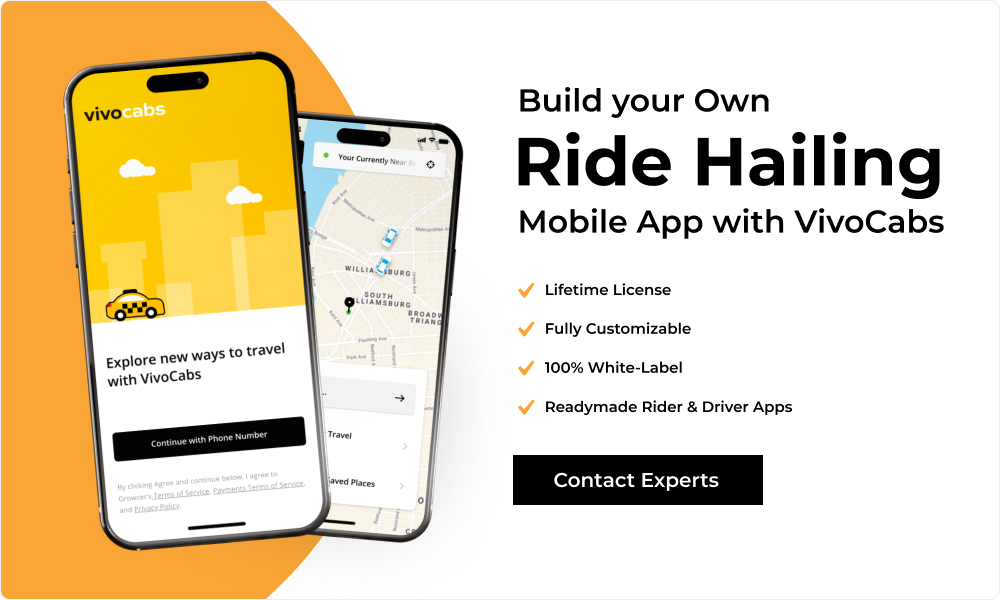
For businesses that don’t want to develop the complete taxi technology infrastructure from scratch, a ready-made white-label software such as VivoCabs can provide that foundation. VivoCabs provides the core mobility technology for riders, drivers, and administrators, which businesses can use to build their branded taxi platform and adapt it to their expansion requirements.
This approach allows the business to focus its development efforts on market-specific requirements, integrations, branding, workflows, and new services instead of rebuilding standard taxi functionality for every expansion.
Looking To Develop Your Own Taxi App?
6. Use a White-Label Ride-Hailing Software to Enter Markets Faster
A white-label ride-hailing software includes customer-facing applications, driver applications, administrative functionality, booking management, payment integration, notifications, trip management, location functionality, reporting, and numerous supporting workflows.
For an established taxi business, spending a significant amount of time recreating standard transportation functionality may delay market expansion.
A white-label taxi software provides an alternative approach.
With a solution such as VivoCabs, businesses can use an existing taxi software foundation and launch it under their own brand. This allows the development effort to focus more heavily on market-specific requirements, integrations, branding, workflows, and expansion needs rather than rebuilding every standard taxi function from zero.
This approach can be especially useful when your expansion plan involves multiple markets.
7. Create a Consistent Customer Experience Across Locations
The more user-friendly your application is, the more amount of revenue it is likely to generate. If you launch an application in a new city, customers should not have to learn an entirely different system every time your business enters a new city.
A consistent digital experience can strengthen brand recognition across markets.
Your customer application should have the following functions easily accessible:
- Select a pickup location
- Choose a destination
- Select an appropriate vehicle or ride category
- View estimated trip information
- Book a ride
- Track the trip
- Make payments
- View booking history
- Manage account information
- Contact relevant customer support channels
At the same time, local differences can be incorporated where necessary for better usability
For example, one market may require a specific payment method, while another may have different vehicle categories or pricing structures.
8. Build a Strong Driver Acquisition Strategy
Expanding your business means not only finding new customers who use your app, but also finding more drivers to serve them. It is a balance between both parties.
Before launching a new market, determine how you will acquire and onboard drivers.
Potential strategies include:
- Partnering with existing taxi operators
- Working with independent drivers
- Partnering with fleet owners
- Recruiting professional drivers
- Offering referral programs
- Building relationships with transportation companies
- Establishing local driver acquisition teams
Your technology should make driver onboarding and management easier as the business grows.
9. Partner With Existing Fleet Owners
You can’t always rely on large capital every time you want to take a step toward expanding your business. Sometimes you can do other things,
like building partnerships with existing fleet owners and transportation operators. In this case, you don’t have to buy a fleet of cars you own.
For example, your platform could bring together:
Your brand + technology + customers + fleet partners while participating vehicle owners provide transportation capacity.
This model can be useful in markets where established transportation operators already have vehicles and drivers but lack a modern digital booking platform.
10. Expand Into Corporate Transportation
Corporate transportation is another stable income avenue that you can use to expand your taxi business.
Businesses may require transportation for employees, executives, customers, airport transfers, meetings, events, or regular business travel.
A taxi company can create dedicated corporate transportation services instead of relying entirely on individual on-demand bookings.
A corporate offering may include:
- Corporate accounts
- Centralized billing
- Employee or passenger management
- Scheduled rides
- Business-specific booking workflows
- Ride history
- Account-level reporting
- Multiple authorized users
- Customized pricing or agreements
This can transform the taxi business from a purely consumer-focused service into a broader transportation provider.
It can also create opportunities for longer-term commercial relationships with companies, hotels, travel businesses, and other organizations.
11. Expand Through Tourism and Hospitality Partnerships
Tourism creates another opportunity for taxi businesses to expand beyond everyday urban transportation.
Hotels, resorts, travel agencies, tour operators, and destination-management businesses may require reliable transportation services for their customers.
A taxi company can develop partnerships around:
- Airport transfers
- Hotel transportation
- Sightseeing transportation
- Tourist vehicle services
- Intercity travel
- Group transportation
- Pre-booked rides
These partnerships can help generate bookings without relying exclusively on direct consumer advertising.
12. Invest in Marketing Alongside Technology
You can’t rely on just one aspect to scale your business; multiple factors come into play when it comes to expansion. Like relying just on a technology upgrade will not help; you also need a solid marketing strategy.
Every new market requires customer acquisition.
Your marketing strategy can combine:
- Local SEO: Create location-specific pages and optimize your online presence for relevant transportation searches.
- Paid advertising: Target customers searching for taxi, airport transfer, corporate transportation, and other relevant services.
- Partnership marketing: Work with hotels, businesses, travel companies, event organizers, and local transportation partners.
- Referral programs: Encourage existing customers and drivers to introduce new users.
- Content marketing: Develop useful content around local transportation, airport transfers, tourism, and travel requirements.
- Brand marketing: Build recognition so that customers associate your brand with transportation services across multiple locations.
The technology and marketing strategies should therefore grow together.
How VivoCabs Can Support Taxi Business Expansion
For a taxi business planning expansion in 2026-27, technology should be considered part of the growth infrastructure rather than simply an app development expense.
VivoCabs provides a white-label, self-hosted taxi and ride-hailing software foundation that businesses can use to build their own branded transportation platform.
It includes the core technology components for riders, drivers, and administrators, providing a starting point for businesses that want to digitize or expand their taxi operations.
For an expansion-focused business, the platform can be used as the foundation for:
- Launching a branded taxi booking platform
- Expanding into additional cities
- Managing multiple service areas
- Supporting different ride categories
- Building driver networks
- Adding payment integrations
- Supporting scheduled transportation
- Developing corporate transportation services
- Introducing specialized transportation services
- Extending the platform through customization and integrations
If you choose a ready-made taxi functionality foundation software, it not only reduces the effort of building from scratch, but also lets the business direct more of its technology investment toward the areas that truly differentiate its expansion strategy.
For example, instead of spending the entire development effort recreating basic booking functionality, the business can focus on market-specific integrations, corporate workflows, local payment requirements, specialized services, branding, and other requirements that support its growth plan.
Find How VivoCabs Can Help You Launch Taxi App
Final Thoughts
Expanding a taxi business in 2026-27 requires more than increasing the number of vehicles on the road. Sustainable expansion involves choosing the right markets, developing reliable driver capacity, diversifying transportation services, building partnerships, strengthening customer acquisition, and creating technology that can support increasing operational complexity.
The most scalable approach is to think of expansion as a combination of market growth, service diversification, operational standardization, and technology infrastructure.
A business can start by strengthening its existing market, enter one carefully selected new location, validate the operating model, and then replicate that model across additional cities or regions.
Technology becomes particularly important during this process. Instead of rebuilding the taxi application every time the business expands, a scalable platform can provide a common foundation that supports new locations, services, drivers, customers, payments, and operational requirements.
Looking To Expand Your Taxi Business?
Get In TouchPopular Posts