

With a tech-savvy population and a regulatory environment that prioritizes safety and professionalism, the Irish market is mature for innovation, particularly in underserved regions and niche segments. Launching a taxi app in Ireland represents a significant opportunity in one of Europe’s most dynamic transportation landscapes.
Moreover, Ireland’s taxi market is unique compared to its European neighbors. Unlike many countries where ride-sharing, using private cars, is common, Ireland strictly regulates all SPSVs (Small Public Service Vehicles). This means every vehicle available for hire through an app must be a licensed taxi, hackney, or limousine. In 2026, the market is characterized by a strong push toward electrification (EVs) and a high dependency on mobile apps for urban transport.
If you are an entrepreneur or startup inclined to enter this booming industry, this blog is for you. It provides a comprehensive roadmap that navigates the legal, technical, and operational complexities of the Irish taxi industry.
Table of Contents
App-Based Transport in Ireland
The app-first mentality has taken over Irish cities. From the dominance of players like Freenow by Lyft to local players like Lynk and VIP Taxis, passengers prefer booking a cab on an app instead of hailing. Moreover, the convenience of digital payments, real-time tracking, and pre-booking has made app-based transport the default choice for many, including commuters, tourists, and corporate clients alike.
Why is Ireland an Attractive Market for Taxi Startups?
Ireland offers a compelling environment for taxi startups that are willing to build compliant, technology-driven, and locally focused ride-hailing services. Further, Widespread smartphone adoption and ongoing transport capacity challenges have created clear gaps that new taxi platforms can address effectively. Thus, it presents a lucrative opportunity for entrepreneurs to enter Ireland’s mobility industry.
1. High Demand-Supply Gap: During peak commuting hours and busy weekend nights in Dublin and Cork, the demand frequently exceeds the number of available taxis. Long wait times and booking failures highlight a clear opportunity for new platforms that can improve driver availability and dispatch efficiency.
2. Tech Hub Infrastructure: Ireland’s status as a European tech hub provides access to top-tier developers and a population that adapts quickly to new digital services. This environment makes it easier to launch, scale, and continuously enhance a modern taxi platform.
3. Expanding Urban Centers: With the ‘Project Ireland 2040’ initiative, cities like Galway and Limerick are expanding rapidly, opening the door for taxi startups to establish an early and lasting presence.
Core Features Required for a Taxi App
To stay competitive in the 2026 on-demand transport market, your app must go beyond basic booking. It needs to be an ecosystem that serves three distinct users. Hence, it should incorporate the following features:
Passenger App Features
1. User Registration & Profile: Social login, phone verification (OTP), and saved Home/Work locations significantly improve usability.
2. Ride Booking & Scheduling: Options for Ride Now or Schedule for Later are vital for airport transfers, early morning travel, and business trips, creating a major revenue stream in Ireland.
3. Real-time Driver Tracking: High-precision GPS tracking with accurate ETAs help passenger feel informed and reduces cancellations.
4. Fare Estimation: Provide a transparent price range before confirming the ride. Estimates must align with the National Maximum Taxi Fare to ensure compliance and avoid disputes.
5. Multiple Payment Options: Integration with payment gateways, such as Stripe for credit/debit cards, Apple Pay, Google Pay, and a Cash toggle popular in rural Ireland, ensures accessibility.
6. Safety Features: A built-in SOS button and trip-sharing with trusted contacts are no longer optional. These features help build credibility.
Driver App Features
1. Onboarding & Document Upload: Drivers should be able to upload and manage their required documents, such as SPSV License and Insurance documents, directly within the app for faster verification and approvals.
2. Trip Management: A clear, intuitive interface allows drivers to accept, reject, or start trips easily with built-in navigation and improve route efficiency.
3. Earnings Dashboard: Real-time tracking of daily and weekly earnings, including tips, gives drivers better financial control and motivates consistent platform usage.
4. Availability Toggle: A simple online or offline button allows drivers to manage working hours on their own terms, supporting flexibility and work-life balance.
5. In-app Support: Direct access to support from the admin team helps resolve trip issues, payment concerns, or technical problems without disrupting driver workflows.
Admin Panel Features
1. Fleet Management: Admin/s need a centralized view of all active drivers, vehicles, and license validity to ensure smooth operations and regulatory compliance.
2. Analytics & Reports: Detailed reports and heatmaps help identify high-demand areas, peak hours, cancellation trends, and rider behavior, enabling data-driven decisions.
3. Pricing Control: Ability to set commissions and manage surge pricing for applicable services, while staying within legal limits.
4. Dispute Management: Access to ride history, GPS logs, and timestamps makes it easier to resolve complaints fairly and quickly, protecting both drivers and passengers.
Build a Feature-Rich Taxi App Suitable for the Irish Market
Steps to Launch a Taxi App in Ireland
The success of launching a taxi app in Ireland depends on a clear market focus, strict regulatory compliance, and a deep understanding of how Ireland’s taxi ecosystem operates. From identifying unmet demand to securing the right licenses and meeting data protection standards, each step plays a critical role in building a sustainable and legally compliant platform.
Step 1: Market Research and Competitor Analysis
Before investing in development, it is essential to understand where real opportunities exist. Analyze what market strategy and business model major platforms like Free Now or Uber follow. Conduct market research and seek answer of the questions:
a. Are they missing a presence in Athlone?
b. Is there any unmet gap in the market?
c. Is their corporate booking interface clunky?
Moreover, your niche could be premium executive hire or contracted school runs.
Step 2: Legal Registrations and Compliance
Regulatory compliance is the most critical and non-negotiable aspect of launching a taxi app in Ireland. All taxi operations are regulated by the National Transport Authority (NTA), and failure to comply can prevent your platform from operating altogether.
1. Overview of Taxi Regulation
In Ireland, you don’t just launch a ride-sharing app in the traditional sense, you launch a Dispatch Operator. Under the Taxi Regulation Acts, any person or company that receives bookings and dispatches vehicles must hold a Dispatch Operator License.
2. The Role of the NTA
The NTA sets fare structures, vehicle standards, and driver conduct across the country. Your app must ensure that your app’s fare calculator aligns with the National Maximum Taxi Fare Order and supports transparency for both drivers and passengers.
| Category | Description | Meter Required? | Bus Lane Access? |
| Taxi | Can be hailed on the street or at ranks. | Yes | Yes |
| Hackney | Pre-booked only; cannot be hailed. | No (Agreed fare) | No |
| Limousine | High-end vehicles for special events. | No (Agreed fare) | No |
3. Driver & Vehicle Requirements
a. SPSV Driver License: Drivers must pass an Industry Knowledge and Area Knowledge test.
b. Vehicle Suitability: Vehicles must undergo an Initial Suitability Inspection. In 2026, there are significant grants (eSPSV25) for drivers switching to Electric Vehicles.
c. Insurance: Must be a specific Small Public Service Vehicle insurance policy.
4. Data Protection & GDPR
Since you are collecting location data and payment info, your app must comply with Irish and EU GDPR laws. This includes data encryption, Right to be Forgotten features, and transparent Privacy Policies.
Step 3: Choosing the Right Development Approach
Selecting the right development approach is a strategic decision that directly impacts your launch timeline, budget, and ability to scale. At this stage, you must balance speed-to-market with flexibility, while ensuring your platform can meet Ireland’s regulatory and operational demands from day one.
A: Custom Taxi App Development
Building a taxi app from the ground up gives you complete control over functionality, design, and user experience. This approach is best suited for enterprises with highly specific requirements and larger budgets.
a. Pros: Unique features, total ownership of source code, and ability to build a highly specific brand.
b. Cons: High cost, ranging from €30,000 to €100,000+, and long time-to-market from 6-12 months.
B: Readymade (White-Label) Taxi App Solution
For most startups and fleet operators, a white-label solution offers a faster and more cost-effective path to market. These platforms come pre-built with core features that are already tested and optimized for real-world operations.
a. Pros: Launch in weeks, significantly lower upfront cost, and built-in features that are already market-proven.
b. Cons: Less flexibility compared to custom development, though modern solutions are highly modular.
VivoCabs: The Best Taxi App Solution for Ireland
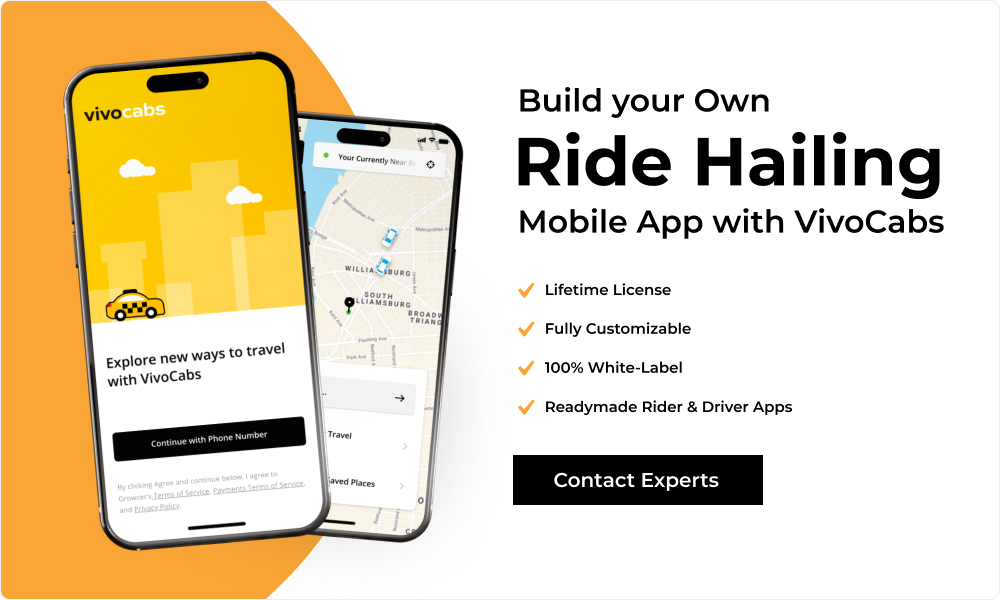
For businesses looking to launch quickly without the risks and delays of custom development, VivoCabs by FATbit Technologies is robust white-label taxi app solution designed for modern taxi operations.
It is not just a basic clone but an enterprise-grade level solution built specifically to handle compliance, scalability, and real-world dispatch complexities. This makes it well-suited for the Irish taxi ecosystem.
Why Choose VivoCabs?
1. Lifetime Ownership: Unlike SaaS models, where you pay every month, VivoCabs offers a one-time payment model. Hence, you own the license forever.
2. Compliance-Ready: VivoCabs is GDPR compliant, key to launch ride-hailing app in Ireland
3. Advanced Ride Bidding: One of VivoCabs’ unique features is a bidding system. For hackneys or long-distance inter-city trips, such as Dublin to Cork, passengers can propose a fare, and drivers can counter-offer, a great way to win market share in the pre-booked segment.
4. Multi-Language & Currency: Fully localized for the Irish market, as it supports multiple languages and currencies, including the Euro and English/Irish language.
5. Safety First: Includes SOS alerts, driver verification modules, and real-time trip sharing.
Ireland-Based Ride-Hailing App Powered by VivoCabs
1. LiDo to Go: LiDo to Go is an Ireland-focused ride-hailing app built using VivoCabs. Designed to make urban and rural travel easier, more reliable, and accessible to a broad range of users. It combines a user-friendly booking interface with essential mobility features, offering a seamless taxi experience that meets the expectations of both riders and drivers in the Irish market.
Discover How VivoCabs Fits the Irish Market
Step 4: Marketing Strategies to Grow Your Taxi App
Once your app is live, growth becomes the next challenge. Taxi platforms face a classic two-sided problem i.e., drivers to attract passengers, and enough passengers to keep drivers active. Solving this requires focused, local-first marketing strategies.
1. Local SEO and Google Business
When people search for Taxi near me or Taxi to Dublin Airport, your website needs to appear. Optimize youe website for local keywords like Galway Taxi App or Waterford Cab Service.
2. Driver Acquisition Strategies
Drivers are your most valuable asset. To win them over from giants like Free Now, you should offer:
a. Lower Commission: Offer a 5%-10% commission for the first six months.
b. Instant Payouts: Use Stripe Connect to offer daily or instant cash-outs, which is a major pain point for drivers.
c. Driver Referral Bonus: Give drivers a bonus for every fellow licensed driver they bring to the platform.
3. Paid Ads & ASO (App Store Optimization)
Run highly targeted Instagram and TikTok ads aimed at the late-night going-out crowd. Ensure your App Store screenshots highlight the safety and fixed-price aspects of your service.
Conclusion
Launching a taxi app in Ireland in 2026 is no longer about just having an app. It’s about providing a reliable, compliant, and localized service that understands the specific needs of Irish commuters. By strictly adhering to NTA regulations, choosing a robust technical foundation like VivoCabs, and focusing on high-growth areas outside of the saturated Dublin city center, your startup can carve out a profitable niche.
The transport industry is shifting toward more transparent, green, and user-centric models. Thus, if you can provide a platform that treats drivers fairly and gives passengers what they want, you have the roadmap to a successful Irish tech story.
FAQs
Q 1. Is ride-sharing with private cars legal in Ireland?
Ans. No, ride-sharing using private, non-licensed vehicles is not legal in Ireland. All vehicles operating through a taxi app must be licensed as Small Public Service Vehicles (SPSVs), Taxi, Hackney, or Limousine, and regulated by the National Transport Authority (NTA).
Q 2. Do I need a license to operate a taxi app in Ireland?
Ans. Yes, if your platform receives bookings and dispatches vehicles, you must obtain a Dispatch Operator License from the NTA. Operating without this license can result in penalties and enforcement actions.
Q 3. What is the difference between Taxi, Hackney, and Limousine services?
Ans. a. Taxi: Can be hailed on the street or booked via app. Additionally, it must use a fare meter and can access bus lanes.
b. Hackney: It is pre-booked only, fares are agreed in advance, and it does not have bus lane access.
c. Limousine: Premium vehicles for events or executive travel. Mostly, it’s pre-booked with agreed fares.
Q 4. How much does it cost to build a taxi app in Ireland?
Ans. The cost depends on the development approach:
a. Custom Development: €30,000 to €100,000+ with 6-12 months development time.
b. Readymade/White-label Solution: Significantly lower upfront cost, with launch possible in a few weeks.
Q 5. What features are mandatory for a taxi app in Ireland?
Ans. A compliant taxi app should include the following features:
a. Real-time GPS tracking
b. Fare calculation aligned with the National Maximum Taxi Fare
c. Driver’s license and document verification
d. Secure digital payments
e. SOS and trip-sharing safety features
f. GDPR-compliant data handling
Q 6. Can taxi apps use surge pricing in Ireland?
Ans. Yes, surge pricing is highly regulated. However, taxis must follow the National Maximum Taxi Fare Order, while hackneys can use agreed fares. Other than that, any dynamic pricing must stay within legal boundaries and be clearly communicated to passengers.
Q 7. Are electric vehicles encouraged for taxi businesses in Ireland?
Ans. Yes, Ireland actively promotes EV adoption in the taxi sector. In 2026, drivers can access government grants such as eSPSV (Electric Small Public Service Vehicle) schemes, making electric taxis a cost-effective and future-proof option.
Q 8. How long does it take to launch a taxi app in Ireland?
Ans. The time to launch a taxi app in Ireland depends mainly on the development approach you use. Two most popular approaches include: custom development and leveraging a white label solution, such as VivoCabs. The time to launch with:
a. Custom development: 6-12 months, including testing and compliance setup.
b. White label solution like VivoCabs: As little as 2-4 weeks, depending on customization and approvals.
Q 9. Is GDPR compliance mandatory for taxi apps in Ireland?
Ans. Yes, taxi apps collect sensitive user data such as location and payment details, making GDPR compliance mandatory. This includes data encryption, user consent management, privacy policies, and data deletion rights.
Q 10. Why choose a white-label solution like VivoCabs for Ireland?
Ans. A white-label solution like VivoCabs helps you:
a. Launch faster with lower technical risk
b. Avoid recurring SaaS commissions through lifetime ownership
c. Scale easily across multiple Irish cities
d. Focus more on driver acquisition and growth rather than development issues
Launch Your Taxi App to Enter the Flourishing Mobility Market of Ireland
Get StartedPopular Posts