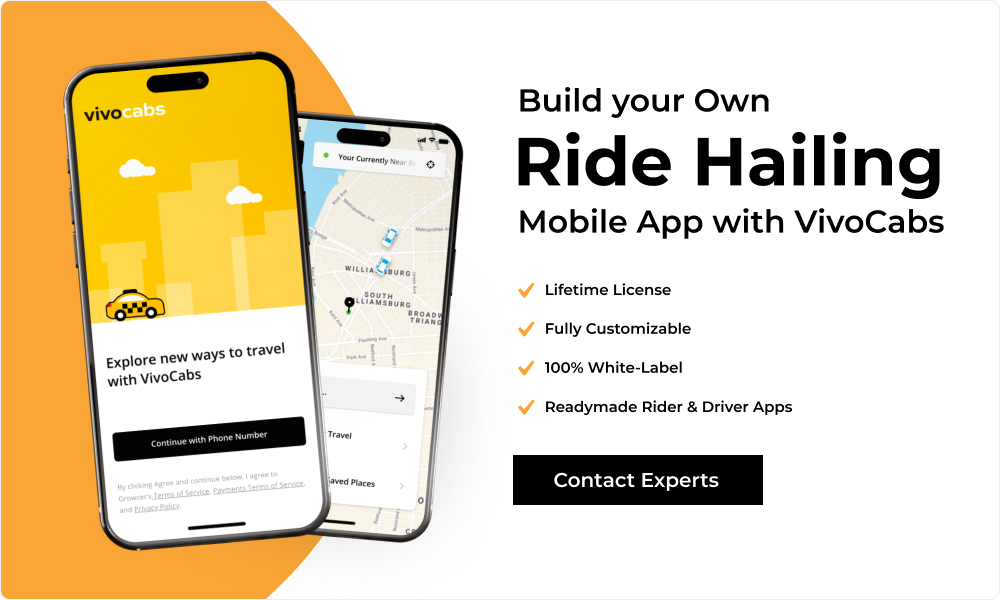


The U.S. ride-hailing and taxi industry is entering a new phase of growth, driven by rising on-demand mobility needs and the rapid digitization of transportation services. Traditional taxi operators, emerging entrepreneurs, and mobility startups are increasingly looking to launch branded taxi apps without the high cost and long timelines associated with custom development.
On the other hand, white-label taxi app solutions have emerged as a practical alternative. These ready-made solutions provide fully functional rider apps, driver apps, and admin panels, enabling businesses to launch quickly, control costs, and scale with confidence. Among the available solutions in the U.S. market, VivoCabs stands out as a leading choice for 2025 due to its balance of affordability, customization, and feature depth.
As rider expectations grow around speed, transparency, and safety, and drivers demand clear earnings and smooth operations, reliable app technology has become essential. Moreover, white-label solutions offer a faster, lower-risk path to meeting these demands and launching a competitive taxi business in weeks rather than years.
Table of Contents
- What Is a White-Label Taxi App Solution?
- Why Businesses Prefer White-Label Apps
- Custom Development vs. White-Label Taxi Solution
- How to Choose the Right Taxi App Solution for Your Business
- Top White-Label Taxi App Solutions in the USA
- Detailed Comparison Table
- Why VivoCabs Stands Out Among All Competitors
- Conclusion
- FAQs
What Is a White-Label Taxi App Solution?
A white-label taxi app solution is a ready-made software that allows businesses to launch their own branded taxi or ride-hailing application without building it from scratch. It typically includes:
- A Rider app
- A Driver app
- An admin panel
Along with essential features such as ride booking, GPS tracking, fare calculation, payments, ratings, and trip history.
The solution is delivered as a pre-built product that can be rebranded with your logo, colors, and business identity. Depending on the provider, businesses can also customize workflows, add features, and integrate third-party services. Furthermore, this approach significantly reduces development time, cost, and technical risk, making white-label taxi apps a preferred choice for startups, fleet owners, and mobility entrepreneurs who want to launch quickly and scale efficiently.
Why Businesses Prefer White-Label Apps?
Businesses prefer white-label taxi apps because they offer:
- Faster launch
- Lower cost
- Proven stability
- Scalable architecture
- Reduces development risk
- Customizable branding
Moreover, these solutions are already developed, tested, and optimized for real-world operations, allowing companies to focus on growth rather than technical complexity. This model has become popular, especially in the USA, where time-to-market and operational reliability are critical.
White-label apps also provide scalable architecture, customizable branding, and ongoing updates, which help businesses adapt as demand grows. For most taxi operators and mobility startups, white-label solutions deliver the reliability and flexibility needed to compete effectively without long development cycles or heavy engineering overhead.
Further, let’s compare custom development and a white-label taxi solution.
Custom Development vs. White-Label Taxi Solution
Choosing between custom taxi app development and a white-label taxi app solution is a critical decision for U.S. taxi operators and mobility entrepreneurs. The right choice directly impacts launch speed, upfront investment, scalability, and long-term operational risk. While custom development offers complete control, it often comes with high costs, extended timelines, and technical uncertainty. In contrast, white-label taxi solutions provide a faster, more affordable, and lower-risk path to launching a branded ride-hailing platform.
The comparison below highlights the key differences across development time, cost, stability, maintenance, scalability, and risk. This breakdown helps startups, fleet owners, and growing mobility businesses clearly understand which approach aligns best with their business goals, budget, and growth plans in the competitive U.S. ride-hailing market.
| Comparison Criteria | Custom Taxi App Development | White-Label Taxi App Solution |
|---|---|---|
| Time to Launch | Built entirely from scratch, covering architecture, UI/UX design, development, testing, integrations, and deployment. Average timeline: 8-18 months | Pre-built system with branding and feature customization only. Average timeline: 1-4 weeks |
| Development Cost | Very high upfront investment, typically ranging from $200,000 to $800,000+ | Low to moderate cost, usually between $2,000 and $25,000, based on customization |
| Testing & Platform Stability | Requires prolonged QA cycles, bug fixing, and real-world testing before stability is achieved | Already tested across multiple deployments and stable from day one |
| Maintenance Responsibility | Full responsibility for bug fixes, server management, OS updates, API changes, and security patches | Ongoing maintenance and periodic updates are generally provided by the vendor |
| Scalability Potential | Scalable, but depends heavily on the quality of the initial system architecture | Designed with proven, scalable architecture to support growing users and fleets |
| Business Risk Level | High risk due to new development, architectural errors, and cost overruns | Low risk since the solution is pre-tested and operationally proven |
Conclusion: Which Is Better?
For 90% of U.S. taxi businesses, white-label apps are the smarter, faster, and more affordable choice. Whereas custom development makes sense only for large brands with unique workflows and million-dollar budgets.
Step Into the U.S. Ride-Hailing Industry with Your Own Brand
How to Choose the Right Taxi App Solution for Your Business
With numerous of taxi app solutions available, selecting the right one requires careful evaluation. Here are the core factors every entrepreneur or fleet owner should consider:
1. Identify Your Business Model and Scale
Ask yourself:
- Are you launching a local taxi service?
- Expanding an existing fleet?
- Planning multi-city operations?
For small businesses, simple solutions like SpotnRides may work. However, for scaling, VivoCabs, Mobisoft, or AllRide are more suitable.
2. Evaluate Customization Requirements
Customization matters if you want your app to stand out. Therefore, choose a solution with:
- High customization (VivoCabs, AllRide) for a unique brand
- Moderate customization (Tagmytaxi, CabStartup) for quick launch
- Basic customization (Hyperlink, SpotnRides) for MVP testing
3. Consider Upfront vs Long-Term Costs
Understand the pricing models:
- One-time cost → Best for long-term ROI (VivoCabs)
- Monthly SaaS fee → Higher total cost over time (CabStartup)
- Premium build cost → Expensive but enterprise-ready (Mobisoft)
Other than that, plan a budget that accounts for:
- App development
- Scaling
- Maintenance
- Marketing
4. Check Technical Features
Before selecting the solution, look for:
- Real-time tracking
- Route optimization
- Multi-city support
- Payment gateways
- Map integrations
Moreover, if you expect growth, avoid platforms with limited scalability.
5. Ensure Strong Post-Launch Support
Mobility businesses rely on uninterrupted technical operations. Thus, you should prioritize vendors that offer:
- Timely support
- Bug fixes
- Updates
- Documentation
- Training
This is where VivoCabs, Mobisoft, and CabStartup perform well.
6. Test the Demo Thoroughly
Before finalizing the solution, check:
- User flow
- Test booking speed
- Evaluate app responsiveness
- Review admin controls
A poor demo usually signals poor performance in real conditions.
Top White-Label Taxi App Solutions in the USA
1. VivoCabs – Best Overall White-Label Taxi App
VivoCabs tops the list of white-label taxi app because it delivers a well-balanced combination of affordability, performance, customization flexibility, and fast deployment. It is an ideal choice for entrepreneurs, new taxi startups, and small to mid-sized operators seeking a modern, fully branded taxi app without the cost and complexity of custom development. The solution includes all essential ride-hailing features, offers a smooth user experience for both riders and drivers, and is built on a scalable architecture that supports future growth. Mentioned below are the key strengths of VivoCabs.
Key Strengths
- Clean, intuitive rider and driver apps
- Essential features for modern taxi operations
- Real-time location tracking
- Fare estimation & secure payments
- Easy onboarding of riders and drivers
- Multi-language & multi-currency support
- Ride history, invoices, and notifications
- Fast launch timelines
Customization & Branding
VivoCabs supports layout modifications, logo integration, UI color changes, and scalable design adjustments. This makes it ideal for creating a branded experience without paying for full custom development.
Why VivoCabs Is Better Than Other Options
- More affordable than most competitors
- Stable performance and clean app flow
- Strong support and documentation
- Quick implementation for time-sensitive businesses
- User-friendly design for both drivers and passengers
Best For
- New startups
- Small to mid-sized taxi services
- Regional mobility operators
- Entrepreneurs wanting to launch fast
VivoCabs ranks at 1 because it offers exactly what most businesses need: a reliable, feature-rich taxi app without unnecessary complexity or high cost.
Schedule a VivoCabs Demo With Our Experts
2. Onde App
Onde App is a white-label taxi and ride-hailing software designed for companies seeking a structured, enterprise-oriented mobility solution. It is commonly used by professional taxi fleets, dispatch centers, and transportation companies that require strong operational control, compliance readiness, and reliability. Onde App focuses on providing a robust back-end system combined with configurable rider and driver applications, making it suitable for businesses with established operations or regulated service requirements.
Strengths
- Strong Dispatch and Fleet Management Capabilities: Onde App is built with advanced dispatching tools that allow operators to manage drivers, monitor vehicle availability, and assign rides efficiently.
- Global Deployment Experience: Onde App has been implemented across multiple regions, supporting businesses that operate in diverse regulatory and operational environments.
Limitations
- Higher Learning Curve: Due to its extensive back-end functionality, the system may require training for administrators and dispatch teams.
- Less Focus on Visual Customization: While functional customization is strong, UI and branding flexibility on the front end may feel limited compared to design-centric white-label solutions.
- Premium Pricing Structure: A Higher price point, which may not align with the budgets of early-stage startups or small local operators.
3. Mobisoft Taxi Booking Software
Mobisoft is positioned as a long-term mobility platform for businesses that prioritize structure, data visibility, and operational control. It is commonly adopted by organizations planning regulated or specialized transportation services where reporting, compliance, and operational insights matter. The solution is well-suited for companies that view their taxi platform as a core digital asset rather than a quick market entry tool, especially those with established processes and growth roadmaps.
Strengths
- Polished UI/UX: This solution offers one of the most refined user experiences, with smooth interactions and well-designed interfaces for both riders and drivers.
- Supports Multiple Ride Types: Mobisoft allows businesses to offer additional ride categories, such as:
- Luxury rides
- Carpooling
- Rentals
- Corporate rides
This gives businesses more revenue opportunities.
Limitations
- Higher Price Range: Mobisoft’s feature set is strong, but the cost is significantly higher than average white-label options, making it less suitable for startups with limited budgets.
- Time-Intensive Customizations: Because the system is extensive, any customization often requires long development cycles.
- Not Ideal for Entrepreneurs with Tight Budgets: It’s best suited for medium to large companies rather than solo founders or local taxi operators.
4. Tagmytaxi
Tagmytaxi is a cloud-based white-label taxi software solution built for rapid deployment and international use. The solution is often chosen by businesses operating across regions or testing multiple markets simultaneously. It works best for teams that want a standardized system with minimal technical involvement and a straightforward operational setup.
Strengths
- Fast and Easy Deployment: Tagmytaxi’s cloud architecture allows businesses to go live within a short time frame, often with minimal technical effort.
- Used Globally: The solution supports clients in multiple countries and offers language/currency adaptability.
Limitations
- Customization Mostly Front-End: Deep backend-level modifications are restricted. The system structure is largely fixed.
- Add-Ons Can Become Pricey: Many useful features are available as add-ons, which increases the overall cost.
- Feature Depth Is Average: Compared to more innovative software, the product offers only moderate functionality.
5. TaxiMobility
TaxiMobility is commonly selected by established taxi companies transitioning from offline dispatch systems to digital platforms. Its design philosophy aligns closely with traditional taxi workflows, making adoption easier for existing staff and drivers. The solution emphasizes operational continuity and reliability over experimentation. It is particularly relevant for long-running fleets that want digital modernization without drastically changing how their business operates day to day.
Strengths
- Proven Reliability: Due to its long presence in the market, TaxiMobility has a tested and dependable architecture.
- Ideal for Traditional Taxi Firms: Companies that want a stable, predictable system with familiar workflows often choose TaxiMobility.
Limitations
- Outdated UI: The interface feels older compared to modern app designs, which may affect user impression.
- Expensive Customizations: Even small modifications often require high development fees.
- Support Responsiveness Varies: Several businesses report delayed responses for support requests.
6. Hyperlink Taxi App Solution
Hyperlink Infosystem offers a taxi booking app solution known for being budget-friendly and visually appealing. It focuses on delivering a presentable, functional product quickly, making it suitable for pilots, local launches, or proof-of-concept deployments. Businesses often use it as a starting point before investing in more advanced platforms, once market demand, user traction, and revenue potential are confirmed.
Strengths
- Very Budget-Friendly: Hyperlink is one of the most affordable providers, making it accessible for founders with limited capital.
- Attractive UI: Design quality is a strong point, with modern interfaces for both drivers and riders.
Limitations
- Limited Feature Depth: The system focuses on basics; advanced ride modules are not included by default.
- Best for MVP, Not Scaling: If your goal is to expand to multiple cities or integrate advanced modules later, you may outgrow the system quickly.
Break into the Mobility Market with Your Own Taxi App
7. CabStartup
CabStartup is a SaaS-based taxi solution ideal for founders who want to launch their taxi apps instantly without managing server infrastructure. It provides essential modules for drivers, riders, and admins, along with automated dispatching and location tracking.
Strengths
- Quick Onboarding and Deployment: Because it’s subscription-based, businesses can get started without long development cycles.
- Solid Support Team: Users often appreciate the responsiveness of CabStartup’s support staff.
Limitations
- You Don’t Fully Own the Software: Unlike one-time purchase solutions, SaaS restricts your control over the product.
- Long-Term Cost Is Higher: Monthly fees add up quickly, becoming more expensive than a one-time purchase.
8. SpotnRides
SpotnRides is a popular white-label taxi app solution designed for startups and small taxi operators who want an affordable and customizable solution without building everything from scratch. It provides rider and driver apps along with an admin dashboard, covering essential functions such as trip booking, real-time tracking, fare estimation, promo codes, push notifications, and wallet payments.
Strengths
- Cost-Effective for New Startups: Most affordable entry points for entrepreneurs who want to validate a taxi business idea without a high upfront investment.
Limitations
- Not Ideal for Large-Scale Expansion: While strong for local and mid-sized businesses, it may lack some enterprise-level features required by big fleets or multi-city operations.
- Moderate Feature Depth: Advanced modules, such as multi-fleet coordination, corporate billing, or premium analytics, are either limited or require additional development costs.
9. AllRide Cab
AllRide Cab targets businesses operating in dense urban environments where efficiency directly impacts margins. It is often adopted by operators who manage high trip volumes and need smarter operational decision-making. The solution is positioned for companies that rely heavily on data-driven optimization to improve fleet utilization and reduce operational waste. It is particularly relevant for metro-focused services with complex routing and traffic challenges.
Strengths
- Good Analytics Tools: The solution offers strong data insights into rider behavior, revenue, and operations.
- Smart Routing: AI-supported routing helps reduce trip time and improves efficiency.
Limitations
- More Expensive Than Typical White-Label Apps: The price range is higher compared to mid-tier solutions.
- Customization Takes Time: The existing architecture is complex, so changes require detailed development cycles.
10. Elluminati Taxi App
Elluminati Taxi App is widely used by entrepreneurs planning launches across multiple regions or countries. Its broad market presence makes it a familiar choice for businesses seeking a globally adaptable solution. The platform is often selected by founders who want a widely deployed system with standardized processes. It suits businesses that prioritize geographical reach and market adaptability over deep structural customization.
Strengths
- Global Compatibility: Supports multiple languages, currencies, and international regulations.
- Cross-Platform Design: Well-designed mobile interfaces for both Android and iOS.
Limitations
- Limited Customization: Some key workflows cannot be changed deeply.
- Performance Depends on Package: Entry-level plans may not deliver optimal speed for high-demand markets.
Detailed Comparison Table
A side-by-side comparison of the top white-label taxi app solutions in the USA helps business owners quickly understand how each platform performs in areas like customization, cost, scalability, and support.
| Solutions | Customization | Pricing | Scalability | Support | Ideal For |
|---|---|---|---|---|---|
| VivoCabs | 5/5 | One-time + affordable | 5/5 | Dedicated | Startups, growing fleets, multi-city operations |
| Onde App | 4/5 | Premium | 4/5 | Strong | Professional fleets, dispatch-based operations, and regulated transport |
| Mobisoft Taxi Software | 4/5 | High | 4/5 | Strong | Paratransit, healthcare, enterprise mobility |
| Tagmytaxi | 3/5 | Moderate | 3/5 | Standard | SMEs needing quick deployment |
| TaxiMobility (NDOT) | 3/5 | High | 4/5 | Mixed | Mature taxi companies & established fleets |
| Hyperlink Taxi Solution | 3/5 | Budget-friendly | 2/5 | Standard | MVPs and early-stage founders |
| CabStartup | 3/5 | Monthly SaaS | 3/5 | Strong | Fast-launch, subscription-based operations |
| SpotnRides | 3/5 | Low | 2/5 | Standard | Startups testing the market |
| AllRide Taxi | 4/5 | Premium | 4/5 | Reliable | AI-driven fleets & metro city operations |
| Elluminati (Eber) | 3/5 | Moderate | 3/5 | Global Support | Local to mid-size operators |
Why VivoCabs Stands Out Among All Competitors
In an increasingly competitive mobility market, choosing the right white-label taxi app can directly affect growth, cost, and long-term sustainability. While several solutions on the list offer decent functionality, VivoCabs clearly positions itself above the rest through a combination of flexibility, affordability, and engineering quality.
1. Superior Customization & Branding Flexibility
Unlike template-based solutions that restrict what you can change, VivoCabs provides deep customization, allowing businesses to build a unique customer experience that aligns with their brand identity.
2. Built with a Strong, Enterprise-Level Architecture
The system is engineered to support high traffic, multi-city operations, and advanced workflows without performance issues, making it future-proof for growing fleets.
3. Lower One-Time Development Cost Compared to Competitors
Most taxi solutions either charge high one-time fees or force businesses into expensive SaaS plans. VivoCabs stands out with its affordable one-time cost, making it ideal for long-term ROI.
4. Built by FATbit Technologies (5,000+ Global Businesses)
Being backed by FATbit Technologies adds credibility, stability, and a strong track record of mobility products that are used worldwide.
5. Better Scalability & Integrations
From integrating multiple payment gateways to advanced map services, telematics, and geo-fencing tools, VivoCabs supports the type of scaling that modern taxi companies require.
6. Smooth Onboarding + Reliable Post-Launch Support
The support team assists throughout deployment, product handover, and after-launch optimization, giving businesses confidence and continuity.
VivoCabs offers the strongest mix of customization, pricing, scalability, and support, making it the most well-rounded white-label taxi app solution in the USA.
Launch Your Branded Taxi App With the Right Technology
Conclusion
The U.S. market for white-label taxi app solutions is competitive, but each solution serves a different type of business. While software like Tagmytaxi, Hyperlink, and SpotnRides are suitable for small or early-stage operators, others like Mobisoft and AllRide target enterprise mobility needs.
However, among all available options, VivoCabs stands out as the most balanced and future-ready choice, combining strong customization capabilities, scalable architecture, an affordable one-time cost model, dependable support, and a modern technology stack that supports long-term growth.
FAQs
Q1. How is VivoCabs different from other white-label taxi app solutions?
Ans. Unlike other template-based white-label taxi app solutions, VivoCabs offers deeper customization, affordable one-time pricing, superior scalability, and enterprise-grade architecture. Additionally, it gives you full ownership of the product without any recurring SaaS charges.
Q2. Is VivoCabs suitable for new taxi businesses or small startups?
Ans. Yes, VivoCabs is suitable for new taxi businesses or small startups. This solution offers quick deployment, essential ride-booking features, and a cost-effective setup without the high investment needed for custom development.
Q3. Can I fully customize the VivoCabs taxi app?
Ans. Yes, you can fully customize the VivoCabs taxi app. It supports extensive customization, including branding, UI changes, workflow modifications, feature enhancements, and integrations, so your app looks and functions exactly the way you want.
Q4. Does VivoCabs offer separate apps for drivers and riders?
Ans. Yes, VivoCabs offers separate apps for drivers and riders. It includes:
- A Rider App
- A Driver App
- An Admin Panel
These three modules work together to deliver seamless booking, tracking, and ride management experiences.
Q5. How long does it take to launch a taxi app with VivoCabs?
Ans. The deployment time to launch a taxi app with VivoCabs varies based on customization. However, most clients can go live within a few weeks. Moreover, if you only require making minimal changes, the launch time is even faster.
Q6. Is VivoCabs a one-time purchase or subscription-based?
Ans. VivoCabs follows a one-time purchase model, offering complete ownership of the solution. This helps businesses avoid high long-term SaaS fees charged by many competitors.
Q7. What features come included with VivoCabs?
Ans. Key features offered by VivoCabs include:
- Real-time GPS tracking
- Fare estimation
- Secure payments
- Trip history & receipts
- Reviews & ratings
- Promo codes
- Multi-language & multi-currency support
Furthermore, advanced features can be added based on your business requirements.
Q8. Can VivoCabs support multi-city or large fleet operations?
Ans. Yes, VivoCabs can support multi-city or large fleet operations. It is built with a scalable architecture that supports multi-city configurations, larger fleets, increasing user traffic, and future expansion without performance issues.
Q9 . Does VivoCabs support integration with payment gateways and maps?
Ans. Yes, VivoCabs supports integration with payment gateways and maps:
- Multiple payment gateways (Stripe, PayPal, Razorpay, etc.)
- Google Maps
- Mapbox
- Third-party telematics and tracking tools
Launch A Ride-Hailing Mobile App With White-Label Solution
Get StartedPopular Posts