

The global taxi and ride-hailing industry continues to grow rapidly as customers increasingly rely on mobile apps for quick, reliable transportation. From everyday city travel and airport transfers to outstation trips and corporate mobility, app-based taxi services have become a core part of modern urban life. As customer expectations evolve, convenience, transparency, and real-time access are no longer differentiators but basic requirements.
At the same time, taxi operators and entrepreneurs are rethinking their reliance on large aggregator platforms. While aggregators offer reach, they often limit control over pricing, commissions, customer data, and branding. In 2026, more businesses are choosing to build their own independent, branded taxi apps to gain ownership, strengthen customer relationships, and improve long-term profitability. This shift reflects a broader move toward sustainable growth rather than short-term visibility.
Choosing the right taxi app solution has therefore become a strategic business decision. A scalable and cost-effective platform must support growing ride volumes, multiple service types, and expansion into new cities without driving up operational costs. The right solution empowers taxi businesses to launch faster, adapt to market changes, and scale with confidence in an increasingly competitive landscape.
Table of Contents
- Why Readymade Taxi App Solutions Are Preferred in 2026
- How to Choose the Right Taxi App Solution in 2026
- Essential Features to Look for in a Taxi App Solution (2026)
- Top Taxi App Solutions to Build a Taxi App in 2026
- What Makes VivoCabs the Best Taxi App Solution in 2026
- Conclusion
- Frequently Asked Questions (FAQs)
Why Readymade Taxi App Solutions Are Preferred in 2026
In 2026, taxi businesses prioritize speed, cost efficiency, and operational reliability as they go digital. Readymade taxi app solutions meet these needs by offering proven technology that supports faster launches, controlled investments, and scalable growth, making them a practical choice for long-term success.
1. Faster Time to Market
Readymade taxi app solutions significantly reduce development time. Instead of spending months on design and development, businesses can go live within weeks using a market-ready, tested solution and start acquiring customers quickly.
2. Lower Upfront Investment
Building a taxi app from the ground up requires high initial investment and ongoing maintenance costs. Whereas, readymade solutions offer predictable pricing and reduce financial risk, making them ideal for startups and growing businesses planning sustainable expansion.
3. Proven and Stable Workflows
These solutions are built on tested workflows refined through multiple deployments. This ensures stable performance, fewer bugs, and smoother operations right from day one.
4. Easier Maintenance and Updates
Ongoing maintenance, feature upgrades, and system updtaes are easier to manage with readymade solutions. This allows businesses to focus more on scaling operations and improving service quality instead of handling technical challenges.
How to Choose the Right Taxi App Solution in 2026
Selecting the right taxi app solution in 2026 goes beyond quick deployment. Businesses must evaluate long-term ownership, scalability, and cost efficiency to ensure the platform can support growth, adapt to market changes, and remain profitable as operations expand.
1. Readymade Taxi App vs Custom Development
Readymade taxi app solutions offer faster launches, proven reliability, and lower costs, while custom development provides full control but requires higher investment and longer timelines. Therefore, most businesses prefer readymade solutions for faster ROI and quick market entry.
2. One-Time License vs Subscription-Based Pricing
One-time license models offer predictable costs, ownership, and long-term savings by eliminating recurring fees. Whereas pricing of subscription-based models may seem affordable initially, but often becomes expensive as ride volume and usage grow.
3. Customization & Branding Control
A good taxi app solution should allow full control over branding customization, including logos, colors, fare rules, and user experience adjustments to help businesses build a recognizable and independent brand.
4. Scalability for Multi-City Operations
The solution must support expansion across multiple cities, regions, and even countries without performance degradation. Built-in scalability ensures smooth operations as driver networks, users, and bookings increase.
5. Data Ownership & Hosting Flexibility
Businesses should retain complete ownership of customer, driver, and ride data, along with the flexibility to choose hosting environments. It enables better control over security and compliance.
6. Technical Support & Update Policy
Reliable technical support and consistent updates help maintain platform stability, security, and feature relevance as market and regulatory requirements evolve.
Looking for a Robust, Future-Ready Taxi App Solution?
Essential Features to Look for in a Taxi App Solution (2026)
A taxi app must deliver more than basic ride booking. Today’s passengers expect speed, transparency, and control at every step of the journey. Therefore, choosing a solution with the right user-focused features directly impacts customer satisfaction, retention, and long-term platform adoption. Given below is a list of essential features that a taxi app solution must offer:
Passenger App Features
- Quick Cab Booking & Ride Scheduling
Passengers should be able to book a cab instantly or schedule rides in advance for airport transfers, office commutes, or planned travel, ensuring convenience and reliability while accommodating both spontaneous and pre-planned journeys.
- Real-Time Trip Tracking
Live trip tracking allows passengers to monitor their cab’s live location on the map. This improves transparency, enhances safety, and builds trust by keeping users informed throughout the journey.
- Fare Estimation & Digital Invoices
Clear fare estimates before booking help passengers understand costs upfront. Automatically generated digital invoices after trip completion eliminate confusion and provide a seamless payment record.
- Multiple Payment Methods
Support for UPI, wallets, debit/credit cards, and cash payments, giving passengers the flexibility to pay using their preferred method, reducing booking friction and improving conversion rates.
- Ratings, Ride History & Customer Support
Passengers should be able to rate drivers, view past trips, and access in-app support for issues related to rides, payments, or refunds. This creates accountability and improves overall user experience.
Driver App Features
- Ride Request Notifications
Drivers receive instant alerts for new ride requests with clear pickup and drop-off details. This enables faster responses, reduces idle time, and helps drivers maximize daily earnings.
- Earnings & Payout Tracking
The app provides a transparent view of daily, weekly, and monthly earnings along with completed trips and payout status. This clarity builds trust and helps drivers plan their income and work more effectively.
- Navigation Assistance
Built-in navigation support guides drivers to pickup and drop locations efficiently. Accurate routing reduces delays, avoids confusion, and improves overall trip completion times.
- Availability Status & Trip Management
Drivers can easily toggle availability, accept or reject rides, and manage ongoing or completed trips with ease. This gives them better control over schedules and workload.
Admin Panel Features
- Driver Onboarding & Verification
Admins can onboard drivers by verifying documents, approving profiles, and managing driver status from a centralized dashboard, ensuring compliance and safety standards.
- Fleet & Vehicle Management
The system helps manage vehicles, assign drivers, monitor availability, and track fleet performance across locations, improving utilization and operational planning.
- Fare Rules & Commission Control
Admins can define fare structures, surge pricing, taxes, and commission percentages based on city, distance, or service type, allowing flexible and profitable pricing strategies.
- Booking, Trip & Cancellation Monitoring
Real-time visibility into active bookings, completed trips, cancellations, and disputes helps admins respond quickly, maintain better operational control, and improve service quality.
- Business Reports & Analytics
Detailed reports on revenue, trips, driver performance, and customer behavior support data-driven decisions and long-term business optimization.
Top Taxi App Solutions to Build a Taxi App in 2026
As competition intensifies in the ride-hailing market, choosing the right taxi app solution in 2026 is critical for long-term success. The solutions below cater to different business sizes, budgets, and growth goals, helping operators launch faster while planning for scalability. Let’s have a look at them:
1. VivoCabs
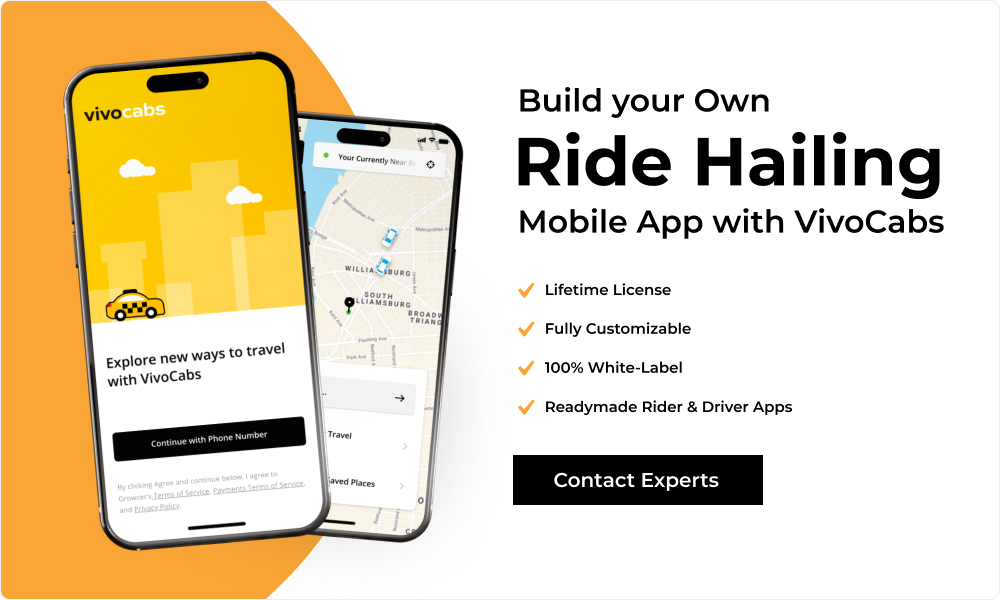
VivoCabs is an enterprise-grade, readymade white-label taxi app solution built for startups, local taxi operators, and large-scale mobility businesses. It offers a complete ecosystem, including a passenger, a driver app, and an admin web panel. VivoCabs is designed to support multiple taxi business models such as local rides, airport transfers, rentals, corporate travel, and outstation services. With a self-hosted, fully white-label setup, it allows businesses to control branding, data, pricing, and workflows while scaling seamlessly across cities without long-term cost escalation.
Why VivoCabs Ranks #1
VivoCabs operates on a one-time license model, eliminating recurring subscription costs. It is fully white-label and self-hosted, giving businesses complete ownership and control. Its scalable architecture, multi-service support, and operational flexibility make it ideal for sustainable, independent taxi platforms.
Key Features
- Admin panel, passenger, and driver app
- Live trip tracking and dispatch system
- Flexible fare, tax, and commission management
- Multiple payment gateway integrations
- Multi-city and multi-service support
Best For: Businesses seeking full ownership, high scalability, and long-term return on investment.
Schedule a One-on-One Demo of VivoCabs
2. Onde App
Onde App is a subscription-based taxi app solution designed to help fleet owners modernize their daily operations with minimal setup effort. It focuses on simplifying ride dispatch, driver coordination, and booking workflows through a centralized system. The solution is commonly adopted by small to mid-sized taxi businesses that want to transition from manual or call-based operations to app-driven management without long development cycles.
Key Features
- Real-time dispatch and ride allocation
- Driver and vehicle tracking tools
- Passenger booking app with basic features
- Centralized admin dashboard
- Automated ride status updates
Limitation
- Ongoing subscription costs
- Expenses increase with scale
- Limited long-term ownership control
- Less flexibility for complex pricing models
3. Yelowsoft
Yelowsoft is a white-label mobility software provider offering solutions for taxi, delivery, and logistics businesses. It provides decent customization options and supports multiple on-demand business models. Other than that, the solution supports configurable workflows and business logic, making it suitable for companies planning service diversification while maintaining centralized operational oversight and brand consistency.
Key Features
- Multi-service mobility support
- White-label apps for users and drivers
- Centralized admin management
- Service-based pricing configuration
- API and third-party integrations
Limitation
- Additional cost for deeper customization
- Feature expansion impacts budget
- Higher total investment over time
- Complexity for smaller operators
4. AllRide Apps
AllRide Apps offers a ready-made taxi app solution designed for fast launches. It emphasizes rapid deployment and ease of use, allowing new operators to validate their business model without prolonged development timelines. The solution is often chosen by early-stage businesses that prioritize speed, simplicity, and market entry over advanced enterprise-level capabilities.
Key Features
- Ready-made passenger and driver apps
- Basic dispatch and booking management
- Simple admin controls
- Multiple payment support
- Fast deployment setup
Limitation
- Limited scalability for large operations
- Fewer advanced analytics tools
- Restricted multi-city expansion
- Not ideal for enterprise growth
5. AtomMobility
AtomMobility is a mobility-focused app development platform supporting taxi, bike, and rental services. It is designed for businesses experimenting with different mobility offerings or planning to operate multiple services under one brand. The platform’s modular approach allows operators to configure services based on evolving business needs while maintaining a unified operational structure.
Key Features
- Multi-mobility service support
- Modular feature architecture
- White-label mobile applications
- Configurable booking workflows
- Admin tools for service management
Limitation
- Add-ons increase overall cost
- Higher maintenance with scale
- Complex setup for small teams
- Advanced features are not included by default
Suggested Read: Top Atom Mobility Alternatives (2026)
6. SpotnRide
SpotnRide offers pre-built taxi app scripts tailored for regional and city-level taxi startups. It focuses on enabling basic digital ride-booking capabilities with moderate customization, helping small operators move online without heavy investment. The solution is commonly used by businesses serving limited geographies that want to replace manual booking systems with a simple, app-based alternative.
Key Features
- Basic passenger and driver apps
- Standard booking and tracking features
- Admin dashboard for ride management
- Payment integration support
- Customizable UI elements
Limitation
- Limited scalability options
- Basic reporting capabilities
- Fewer automation tools
- Not suited for large networks
7. TaxiCaller
TaxiCaller is a taxi dispatch and booking management software known for its strong backend and call-center support. It is widely used by traditional taxi companies transitioning to digital systems. The solution helps operators digitize dispatch workflows while retaining familiar operational structures, making it suitable for companies modernizing legacy taxi systems.
Key Features
- Powerful dispatch management
- Call-center booking support
- Fleet and driver coordination tools
- Real-time ride monitoring
- Reporting and operational insights
Limitation
- Limited front-end branding control
- Basic passenger app customization
- Less focus on app-led growth
- UI flexibility constraints
8. RydeX Taxi
RydeX Taxi is a ready-to-launch taxi app solution designed for budget-conscious startups. It enables new operators to establish an app-based presence quickly without extensive configuration. Additionally, it is generally used by small businesses testing local demand before investing in more advanced systems or broader market expansion.
Key Features
- Core ride-booking functionality
- Passenger and driver applications
- Admin control panel
- Payment gateway integration
- Quick setup process
Limitation
- Limited customization scope
- Not suitable for complex models
- Scalability challenges
- Basic analytics support
9. UnicoTaxi
UnicoTaxi is a cost-effective taxi app solution offering core ride-hailing functionalities. It emphasizes simplicity and affordability, making it suitable for businesses running small fleets or operating within a narrow service area. The platform helps operators digitize bookings and basic ride management without the complexity of enterprise-grade systems.
Key Features
- Basic ride booking system
- Driver and passenger apps
- Simple admin management
- Fare configuration options
- Payment support
Limitation
- Restricted scalability
- Limited customization options
- Not ideal for enterprise use
- Fewer automation features
10. Cab Startup
Cab Startup is a white-label taxi app solution targeted at first-time taxi entrepreneurs. It focuses on quick setup and local market operations. The platform is commonly chosen by new business owners launching local taxi services who want a simple digital foundation before planning long-term scaling or feature expansion.
Key Features
- White-label taxi applications
- Quick deployment model
- Basic dispatch system
- Admin dashboard access
- Payment integration
Limitation
- Limited feature depth
- Scaling challenges over time
- Basic reporting tools
- Not suited for multi-city growth
What Makes VivoCabs the Best Taxi App Solution in 2026
VivoCabs is designed for taxi businesses that want complete ownership, long-term scalability, and predictable costs. Unlike subscription-based platforms, it empowers operators to run their taxi operations independently with full control over branding, data, and business rules.
- Ownership-First Business Model
VivoCabs offers a one-time license, allowing businesses to own the platform outright instead of paying ongoing subscription or per-ride fees.
- Fully White-Label & Self-Hosted
Businesses get complete control over branding, customer data, pricing strategies, and hosting environment without third-party dependency.
- Enterprise-Grade Architecture
Built to handle high traffic, large driver networks, and growing ride volumes without performance issues.
- Supports Multiple Taxi Business Models
From on-demand ride-hailing and corporate transport to airport transfers, rentals, and outstation services, VivoCabs enables multiple offerings through a single unified platform.
- High Scalability for Multi-City Growth
The system is built to expand across cities and regions without operational disruption, making it suitable for long-term growth and geographic expansion.
- Lower Long-Term Cost of Ownership
By eliminating ongoing SaaS fees, VivoCabs helps businesses significantly reduce operational costs as they scale, improving overall profitability.
- Operational Flexibility & Customization
Allows customization of fare rules, commissions, workflows, and app experience to match specific business requirements.
- Long-Term Stability & Growth Readiness
Ideal for entrepreneurs and taxi operators aiming to build a sustainable, independent taxi brand in 2026 and beyond.
Build an Ownership-First Taxi App
Conclusion
Building a successful taxi app in 2026 requires more than just launching an application. It involves selecting a reliable, scalable, and cost-effective taxi app solution that aligns with long-term business goals. Although many platforms offer quick deployment, only a few offer true ownership, operational flexibility, and the ability to scale without limitations.
Among the available options, VivoCabs stands out as the best overall taxi app solution due to its one-time licensing model, full customization capabilities, and enterprise-grade scalability. For entrepreneurs and taxi operators looking to establish a strong and independent presence in the ride-hailing market, selecting the right solution today lays the foundation for sustainable growth and long-term success.
Frequently Asked Questions (FAQs)
Q 1. Who should consider building a taxi app in 2026?
Ans. Local taxi operators, fleet owners, corporate transport providers, airport taxi services, and entrepreneurs who want to run an independent ride-hailing business can benefit from building a taxi app to run an independent ride-hailing business without relying on third-party aggregators.
Q 2. Can a taxi app support multiple services under one platform?
Ans. Yes, modern taxi app solutions can support multiple services such as local rides, airport transfers, corporate bookings, rentals, and outstation trips within a single platform, allowing businesses to diversify revenue streams.
Q 3. How long does it take to launch a taxi app using a readymade solution?
Ans. Most readymade taxi app solutions allow businesses to launch within a few weeks. Timelines depend on branding, customization, and deployment needs, but are much faster than custom development.
Q 4. Is it possible to expand a taxi app business to multiple cities later?
Ans. Yes, it is possible to expand a taxi app business to multiple cities later. Most of the modern solutions are designed to support multi-city and multi-region expansion, enabling businesses to add new locations, onboard drivers, and manage operations seamlessly without rebuilding the platform.
Q 5. Can taxi businesses customize fare rules for different cities or services?
Ans. Most advanced taxi app solutions allow flexible fare configuration. Businesses can set different pricing rules, commissions, taxes, and service charges based on city, distance, vehicle type, or service category.
Q 6. How does owning a taxi app help improve profitability?
Ans. Owning a taxi app eliminates high aggregator commissions, gives full control over pricing, and allows direct customer relationships. This results in better margins, repeat business, and supports long-term profitability.
Q 7. Is technical expertise required to manage a taxi app platform?
Ans. No, technical expertise is not a necessary requirement to manage a taxi app platform. Taxi app solutions typically include an intuitive admin panel that allows business owners to manage drivers, bookings, pricing, and reports without coding knowledge.
Q 8. Can a taxi app be branded completely under my business name?
Ans. Yes, white-label taxi app solutions allow full branding customization, including app name, logo, color scheme, and business identity, helping operators build a recognizable and independent brand.
Q 9. How secure is customer and business data on a self-hosted taxi app?
Ans. Self-hosted taxi app solutions provide full control over data security and hosting. Businesses can choose their preferred hosting environment and ensure compliance with internal security and data protection policies.
Q 10. What should businesses prioritize when selecting a taxi app solution?
Ans. Businesses should prioritize ownership model, scalability, customization flexibility, long-term cost efficiency, and support reliability rather than just upfront pricing or quick launch.
Move Beyond Aggregators and Build Your Own Taxi App
Get StartedPopular Posts