The ride-hailing industry is proliferating, creating major opportunities for entrepreneurs ready to launch their own taxi or cab booking platform. If you’re reading this, you’re probably one of them. But before you invest time, money, or resources, one critical question can shape your entire journey, i.e., should you choose an Uber clone script or build a custom taxi app from scratch? The answer can determine how fast you launch, how much you spend, and how easily you scale.
Both options can help you build a successful ride-hailing business, but they follow different paths. One offers speed, lower costs, and ready-made features. The other gives you full flexibility, unique branding, and complete ownership. However, the “right choice” depends entirely on your business goals, budget, timeline, and long-term vision.
In this guide, we compare Uber clone scripts and custom taxi app development across cost., timeline, customization, scalability, and long-term value, so you can make a confident, well-informed decision for your business.
Table of Contents
Understanding the Two Paths: Uber Clone Script vs Custom Taxi App
Before comparing costs, timelines, and scalability, let’s define what we’re actually talking about.
An Uber clone script is a pre-built, ready-to-launch software solution that replicates the core functionality of Uber. It comes equipped with passenger and driver apps, an admin dashboard, GPS tracking, payment integration, and more. You license the script, white-label it with your brand, customize certain elements, and launch much faster than building from scratch.
A custom taxi app, on the other hand, is built from scratch by a development team. Every screen, feature, workflow, and integration is designed and coded specifically for your business requirements. This approach gives you complete flexibility, but it also requires more time, investment, and technical planning.
Both approaches can result in a professional, functional product. The difference lies in speed, budget, control, and how quickly you want to enter the market.
The Case for Uber Clone Scripts
For many entrepreneurs, speed, affordability, and lower risk are top priorities when entering the ride-hailing market. That is where Uber clone scripts become a practical choice. They provide a ready-made foundation that helps businesses launch faster without starting development from zero.
1. Speed to Market
Time is money, and in a competitive industry, launching months before your rival can mean capturing a significant portion of the market. With an Uber clone script, the foundations are already built and tested. Most reputable clone script providers enable you to go live in a matter of weeks, compared to the 6-18 months a full custom build typically requires.
For entrepreneurs in emerging markets, seasonal businesses, or anyone validating a concept before heavy investment, this speed advantage is invaluable.
2. Lower Upfront Investment
Custom app development is expensive, depending on complexity, platform selection (iOS, Android, web), and the team you hire. Including all this, a fully custom taxi application can cost anywhere from $50,000 to $300,000 or more. And that’s before ongoing maintenance, server costs, and future feature development.
Clone scripts, in contrast, significantly reduce this barrier to entry. Most high-quality solutions are available at a fraction of the custom development cost, often between $2,000 and $15,000, making entrepreneurship accessible even for bootstrapped founders. That allows founders to invest more in marketing, driver onboarding, and daily operations.
3. Proven, Tested Features
When you opt for custom development, you are essentially running a quality assurance experiment on your own dime. That means that bugs will surface you will have to pay the developers to fix them.
Whereas clone scripts have already gone through these growing pains. The core booking flow, driver tracking logic, surge pricing algorithms, and payment gateway integrations have already been tested across many deployments. Thus, instead of reinventing the wheel, you inherit stability.
4. Ongoing Support and Updates
Reputable clone script vendors provide customer support, bug fixes, and feature updates as part of their service model. This is especially helpful for non-technical founders who don’t want to manage a full engineering team.
However, with custom development, maintenance is entirely your responsibility. Which means retaining developers, managing sprints, and budgeting for ongoing engineering costs indefinitely.
5. Feature-Rich from Day One
Modern Uber clone scripts come loaded with the features riders and drivers have come to expect: real-time GPS tracking, in-app chat, multiple payment options, surge pricing, driver ratings, ride scheduling, promo codes, and referral systems. Launching with these features already in place can save months of development time.
Start Smart With a Cost-Effective Uber Clone Script
The Case for Custom Taxi App Development
For businesses with a distinct vision, complex operations, or long-term expansion goals, custom development can be the stronger route. Instead of adapting your idea to fit an existing template, you build a platform designed specifically around your business model.
1. Total Flexibility and Uniqueness
A clone script, by definition, replicates an existing product. If your business model deviates significantly from the Uber model, say, building a specialized medical transport service, a luxury chauffeur platform, a two-wheeler taxi app, or a logistics-integrated mobility product, you may quickly find yourself working against the template rather than with it.
With custom development, you get a blank canvas. Every interaction, every workflow, every data point can be designed around your specific user personas and business logic.
2. Competitive Differentiation
In crowded markets, looking and feeling like a slightly re-skinned Uber can make it hard for your brand to stand out. Users notice.
A custom platform allows you to create your own user experience, fully custom UI/UX, unique features, and bespoke interactions. This can help set your app apart in meaningful ways. If your long-term vision is to build a category-defining mobility brand, custom development gives you the foundation to do so.
3. Full Ownership of Codebase
With most clone scripts, you license software, which may come with restrictions on resale, redistribution, or certain modifications. You may also be dependent on a single vendor for critical updates.
However, with custom development, you own every line of code. There’s no vendor lock-in, no licensing restrictions, and no risk of your vendor going out of business and leaving you stranded.
4. Scalability on Your Terms
While many modern clone scripts are built on scalable cloud infrastructure, they may not handle very large user bases or unusual traffic patterns as gracefully as a purpose-built system.
Thus, if you are planning to scale to millions of rides per day across dozens of cities, custom architecture gives you full control over performance optimization.
5. Regulatory Compliance and Localization
Different markets have different legal requirements, vehicle permit databases, government API integrations, specific data localization laws, and local payment gateways. A custom taxi app can be built with these specific requirements in mind from day one, reducing friction during expansion.
Head-to-Head Comparison
Both options can help you launch a ride-hailing business, but they serve different priorities. Uber clone scripts are ideal for faster launches, lower upfront costs, and proven features, while custom taxi apps are better suited for businesses that need full control, unique functionality, and long-term scalability.
Refer to the comparison table given below to see which path aligns best with your goals:
| Factor | Uber Clone Script | Custom Taxi App |
| Time to Launch | 2-8 weeks | 6-18 months |
| Cost | $2,000-$15,000 | $50,000-$300,000+ |
| Customization | Moderate | Complete |
| Maintenance | Vendor-supported | Self-managed |
| Scalability | Good | Excellent |
| Feature Depth | Ready-made | Build-as-needed |
| Code Ownership | Licensed | Full ownership |
| Risk | Low-Medium | Medium-High |
| Best For | Startups, SMBs, new markets | Large enterprises, unique models |
Who Should Choose a Clone Script?
A clone script is likely the right choice if you:
- Are launching your first ride-hailing business and want to test the market without a massive upfront investment
- Need to launch quickly to capitalize on a market opportunity or seasonal demand
- Are operating in a Tier 2 or Tier 3 city where Uber is absent or underserving riders
- Have a limited budget but still want a professional, feature-rich product
- Want dedicated support without hiring and managing an in-house engineering team
- Plan to scale after validating the concept, and can reinvest revenue into future customization
Choosing a clone script helps you move with speed and confidence, focusing your energy on operations, marketing, and driver acquisition rather than software development cycles.
Launch Your Taxi App Faster With a Clone Script
Who Should Choose Custom Development?
Custom development makes more sense if you:
- Have a highly unique business model that doesn’t map to the Uber template
- Are building for enterprise or institutional clients with specific integration requirements
- Have already validated your concept and are ready to invest in a scalable, differentiated platform
- Operate in a heavily regulated environment with complex compliance needs
- Have the technical team and budget to manage ongoing development
- Are building a venture-backed company that requires full IP ownership
Even in these cases, some businesses start with a clone script to generate revenue and use that capital to fund a custom rebuild later, a smart, phased approach.
Spotlight: VivoCabs, The Best Uber Clone Script on the Market
If you have decided that a clone script is the right path for your business, the next question is: which one?
The market is full of taxi app solutions, but many of them are outdated, poorly supported, or overrun with hidden costs. After careful evaluation, VivoCabs stands out as the most comprehensive, reliable, and future-ready Uber clone script available today.
What Makes VivoCabs Different?
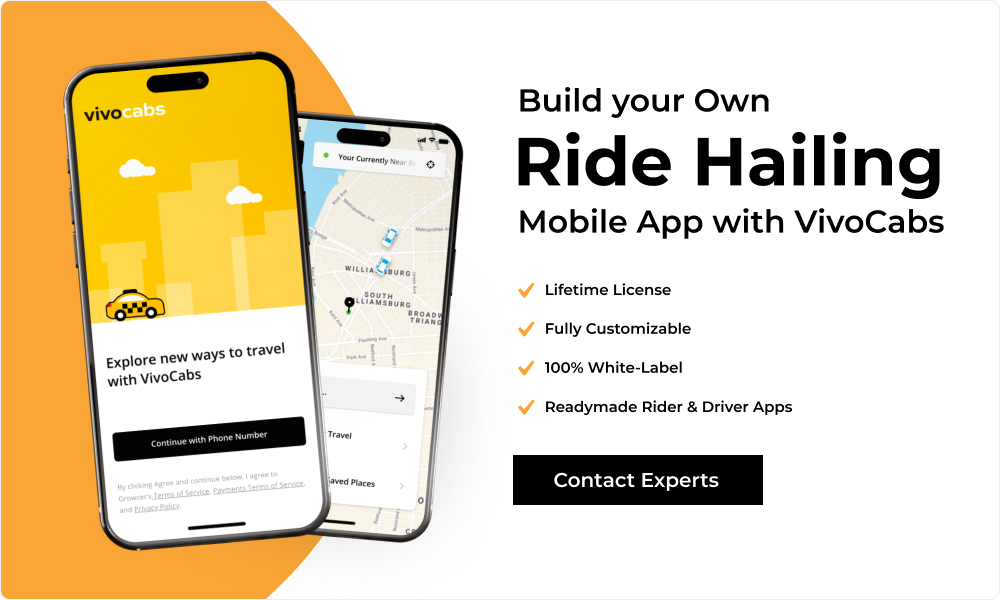
VivoCabs is a fully white-labeled, multi-service ride-hailing software designed for entrepreneurs and fleet operators who want to launch fast without compromising on quality or scalability.
Here’s what sets it apart:
1. Complete App Suite
VivoCabs delivers a full ecosystem, including:
- Rider App (iOS & Android), with intuitive booking, real-time tracking, fare estimation, and in-app payment
- Driver App (iOS & Android), including trip management, earnings dashboard, navigation integration, and availability controls
- Admin Panel, equipped with a powerful web-based backend to manage rides, drivers, pricing, promotions, and analytics
2. Multi-Service Ready
Unlike basic clone scripts that handle only point-to-point rides, VivoCabs supports multiple service types within a single platform, including standard cabs, luxury vehicles, bike taxis, carpooling, and intercity transportation. This makes it ideal for operators who want to offer diverse mobility options from day one.
3. Flexible Pricing Engine
Set flat fares, distance-based pricing, surge multipliers, and zone-based rates independently for each service category. VivoCabs also supports promo codes, referral bonuses, and corporate wallet billing, giving you the tools to compete aggressively on pricing when you need to.
4. Multiple Payment Gateways
VivoCabs supports digital payments, credit/debit cards, eWallets, cash payments, and regional payment gateways. It is also integrated with Stripe, PayPal, and local gateways across Asia, Africa, and Latin America, making it truly global-ready.
5. Real-Time Analytics Dashboard
The admin dashboard provides you deep visibility into booking volumes, revenue trends, driver performance, cancellation rates, and customer retention metrics. This helps make data-driven decisions start from day one.
6. White-Label Branding
Your taxi app launches under your brand, your colors, your name. VivoCabs is fully white-labeled, meaning there’s no vendor branding in the rider or driver apps. From the splash screen to the notification copy, everything carries your identity.
7. Scalable Cloud Architecture
VivoCabs is built on a scalable architecture. Whether you’re serving 500 rides a day or 50,000, the platform scales to match demand, without any performance degradation.
8. Dedicated Support and Customization Services
VivoCabs provides 24/7 technical support, a detailed knowledge base, and optional customization services for businesses that need features beyond the standard package. You’re never left to figure things out alone.
See VivoCabs in Action
VivoCabs in Action: Real-World Applications
VivoCabs has powered ride-hailing and mobility businesses across different countries and industries, showing how flexible the solution can be for entrepreneurs with varied business models:
- ZipCarz
ZipCarz was launched as a tourist-focused ride-hailing platform in Hong Kong. Built to solve travel challenges like language barriers and unreliable transport, it offers seamless booking, secure rides, and a user-friendly experience for international travelers.
ZipCarz Case Study
- RUNR
RUNR used VivoCabs as the foundation for a niche courier platform serving the construction industry. It enables urgent and scheduled material deliveries, proof of delivery, real-time tracking, and multi-order management for time-sensitive job sites.
RUNR App Case Study
- TripLI
TripLI is a Nigeria-based ride-hailing app focused on affordable and dependable transportation. Using VivoCabs, the business launched with custom features such as advanced driver assignment, auto-accept rides, and localized workflows tailored to regional mobility needs.
TripLi App Case Study
Its flexibility, combined with its speed to market and competitive pricing, makes VivoCabs the go-to choice for serious entrepreneurs entering the ride-hailing space.
Common Misconceptions About Clone Scripts
Many founders hesitate to choose a clone script because of outdated assumptions. The reality is that modern taxi clone solutions have evolved significantly and can be a strong launch option when chosen wisely.
Let’s address a few myths that often cause founders to hesitate:
1. “Clone scripts are low quality.”
That may have been true for some older products, but not for today’s leading platforms. Modern solutions like VivoCabs are built by experienced engineering teams using the same technologies and architectural patterns as enterprise applications. The word “clone” usually refers to the business model and feature set, not the software quality.
2. “I’ll get the exact same app as my competitor.”
Your branding, UI customization, feature configuration, pricing strategy, service offerings, and local market strategy all differentiate your product. Two businesses can use similar software foundations and still deliver completely different customer experiences.
3. “I’ll outgrow it quickly.”
A well-built clone script is designed to grow with your business. Many modern solutions, such as VivoCabs, are designed to handle enterprise-level traffic, multi-city expansion, higher rider volumes, and advanced admin controls. And if you eventually need a fully custom solution, you can use your revenue and real-world learnings to make smarter decisions later.
4. “Custom is always better.”
Custom development offers more flexibility, but it is not automatically the better choice. A delayed or poorly managed custom project can underperform compared to a stable, well-deployed clone script. Success often depends more on execution, market timing, and operations than on how the software was built.
A Practical Decision Framework
If you are still unsure? Use this simple framework to identify the best fit for your current stage:
1. What is your budget?
- Under $20,000 → Clone script
- $20,000-$100,000 → Clone script with custom features
- $100,000+ → Custom or heavily customized clone
2. What is your timeline?
- Under 3 months → Clone script
- 3-12 months → Either, depending on feature complexity
- 12+ months acceptable → Custom
3. How unique is your business model
- Standard ride-hailing → Clone script
- Niche modifications → Clone script with custom add-ons
- Fundamentally different model → Custom
4. What is your technical capacity?
- No in-house tech → Clone script with vendor support
- Small tech team → Clone script + custom development
- Full engineering team → Either
Conclusion
There’s no universal answer to the clone script vs. custom development debate, but there is a right answer for your business, given your specific circumstances.
For the vast majority of ride-hailing entrepreneurs, especially those in emerging markets, launching their first platform, or validating a new concept, an Uber clone script offers the fastest, most cost-effective, and lowest-risk path to market. You get enterprise-grade features, proven technology, and the support infrastructure to grow confidently.
VivoCabs stands out by combining fast deployment with the flexibility and scalability serious operators need. If your concept is highly unique and you have the resources, custom development can work, but many founders launch first, learn from the market, and scale smarter later.
FAQs
Q 1. Do Uber clone scripts include source code access?
Ans. Source code access depends on the provider and licensing model. Some offer limited access, while others provide full source code ownership at an additional cost. However, with solutions like VivoCabs, businesses can usually purchase the source code at an additional price, allowing deeper customization and long-term flexibility as they grow.
Q 2. Can I integrate local payment gateways with a taxi app?
Ans. Yes, most modern taxi-app solutions support integration with regional payment gateways. This is especially important for serving local users who prefer familiar options, such as UPI, wallets, and local banking transfers. Solutions like VivoCabs are built to support both global and market-specific payment methods.
Q 3. Does VivoCabs support multi-language and multi-currency features?
Ans. Yes, VivoCabs supports both multi-language and multi-currency functionality, making it easier to expand your ride-hailing business into different regions. This helps businesses serve diverse customer groups, improve user experience, and expand into new markets without rebuilding the platform for every region.
Q 4. How are app updates and maintenance handled?
Ans. With VivoCabs, the vendor typically provides:
- Regular software updates
- Bug fixes
- Optional upgrade services
This reduces the need for managing a full in-house tech team while keeping the platform reliable.
Q 5. Can I manage commissions and driver payouts in VivoCabs?
Ans. Yes, VivoCabs includes admin tools to manage commissions, track driver earnings, and manage payouts. You can set earning rules based on your business model, service type or region. This gives operators more control over revenue management and driver payment workflows.
Build Your Ride-Hailing App the Smart Way
Get In TouchPopular Posts