
AI Overview:
The ride-hailing industry continues to grow as consumers increasingly prefer convenient, on-demand transportation services. This guide explains how to build a successful ride-hailing app by covering business models, essential rider, driver, and admin features, development approaches, monetization strategies, and marketing tips. At the same time, the guide explores how white-label software, VivoCabs, can help entrepreneurs launch a scalable ride-hailing platform faster and more cost-effectively.
The ride-hailing industry has revolutionized the way people commute, making transportation more convenient, accessible, and efficient than ever before. Standing at the forefront of this revolution are leading platforms like Uber, Lyft, Bolt, Careem, and Grab. They have redefined urban mobility by connecting riders with nearby drivers through intuitive mobile applications, creating seamless experiences for users while unlocking lucrative business opportunities for entrepreneurs.
Driven by the widespread adoption of smartphones, GPS technology, digital payment systems, and real-time location tracking, the global demand for ride-hailing services continues to grow. However, developing a successful ride-hailing app requires selecting the right business model, integrating essential features like real-time dispatching and secure payments, building a scalable technology infrastructure, complying with local transportation regulations, and creating a reliable experience for both riders and drivers. Every decision, from feature prioritization to technology selection, can significantly impact your platform’s performance, scalability, and long-term profitability.
Whether you’re a startup founder, transportation company, or entrepreneur looking to build the next Uber-like platform, this comprehensive guide will walk you through every stage of ride-hailing app development. Additionally, you will learn about different business models, must-have features, the development process, estimated costs, and the most effective approaches to launching a successful ride-hailing business in today’s competitive market.
Table of Contents
Understanding the Ride-Hailing Ecosystem
A successful ride-hailing platform relies on multiple interconnected components that work together to deliver a seamless experience for riders, drivers, and administrators. Each module plays a distinct role in streamlining ride bookings, trip management, payments, and overall business operations.
A well-structured ecosystem not only enhances user satisfaction but also improves operational efficiency, enabling businesses to scale their services while maintaining reliability, security, and profitability.
A typical ride-hailing ecosystem consists of:
- Rider App: Allows passengers to book rides, track drivers in real time, make payments, and view ride history.
- Driver App: Enables drivers to accept ride requests, navigate to destinations, manage availability, and monitor their earnings.
- Admin Dashboard: A centralized control panel for managing users, drivers, pricing, commissions, reports, promotions, and platform settings.
- Dispatcher Panel (Optional): Helps dispatch operators manually assign rides and efficiently manage bookings.
- Website or Landing Pages: Support customer acquisition, business information, and driver onboarding.
- Payment Gateway Integration: Facilitates secure online payments through multiple payment methods.
- GPS & Navigation Services: Power real-time location tracking, route optimization, and driver-passenger matching.
- Push Notification System: Sends instant alerts for ride requests, booking confirmations, driver arrivals, and promotional campaigns.
Key Functionalities for Riders
A rider app is designed to provide a fast, convenient, and secure booking experience. Passengers can:
- Book rides instantly or schedule them for a later time.
- View estimated fares before confirming a trip.
- Track their assigned driver in real time.
- Choose from multiple vehicle categories.
- Pay securely using cashless payment methods.
- Access ride history and digital receipts.
- Rate drivers and provide feedback after each trip.
Key Functionalities for Drivers
The driver app streamlines ride management and helps maximize productivity. Drivers can:
- Receive and accept nearby ride requests.
- Navigate efficiently using integrated GPS.
- Set their availability status (online/offline).
- Track daily, weekly, or monthly earnings.
- Manage completed trips and ride history.
- Receive payouts and monitor account balances.
- View passenger ratings and maintain service quality.
Admin Management
The admin dashboard serves as the operational hub of the ride-hailing platform. From a single interface, administrators can oversee the entire business by managing riders, drivers, vehicles, commissions, pricing rules, payments, promotional campaigns, customer support, analytics, and platform performance. This centralized control ensures smooth day-to-day operations while providing valuable insights to support business growth and scalability.
Build a Seamless Mobility App with Essential Modules
How Does a Ride-Hailing App Work?
While booking a ride takes only a few taps for users, a ride-hailing platform relies on several interconnected technologies working seamlessly behind the scenes. From GPS and real-time driver matching to fare calculation and secure payment processing, every stage is designed to provide a fast, reliable, and convenient experience for both riders and drivers.
Here’s how a typical ride booking process works:
Stage 1: Rider Requests a Ride
The rider enters the pickup and destination locations, selects their preferred vehicle category, and confirms the booking. Depending on the platform, users may also schedule rides for a later time.
Stage 2: Fare Estimation
Before the ride is confirmed, the app provides an estimated fare based on multiple factors, including:
- Travel distance
- Estimated trip duration
- Real-time traffic conditions
- Selected vehicle category
- Dynamic or surge pricing (if applicable)
Displaying an upfront fare estimate helps passengers make informed decisions and improves pricing transparency.
Stage 3: Driver Matching and Ride Dispatch
Once the ride request is submitted, the platform uses GPS technology and intelligent dispatch algorithms to identify nearby available drivers. It considers factors such as driver proximity, vehicle type, availability, and estimated arrival time to assign the most suitable driver.
Step 4: Ride Acceptance
The selected driver receives the booking request with trip details, including the pickup location, estimated distance, and destination, and can accept or decline it. If the request is declined, the system automatically forwards it to another nearby available driver.
Stage 5: Real-Time Ride Tracking
After the driver accepts the request, both the rider and driver can track each other’s live location within the app. Live navigation and ETA updates improve convenience, transparency, and safety.
Stage 6: Trip Completion
After reaching the destination, the driver marks the trip as completed. The system then calculates the final fare by considering factors such as the actual travel distance, trip duration, waiting time, toll charges (if applicable), and any dynamic pricing adjustments.
Stage 7: Secure Payment Processing
After the ride ends, the payment is processed using the rider’s selected payment method. Most ride-hailing platforms support multiple payment options, including:
- Credit and debit cards
- Digital wallets
- Cash payments
- Mobile payment applications
- Online banking (depending on the region)
Step 8: Ratings and Reviews
The final step is the feedback process. Both riders and drivers can rate each other and share feedback. This two-way rating system helps maintain service quality, encourages professional behavior, and builds trust.
Types of Ride-Hailing Apps
The ride-hailing industry encompasses a wide range of business models, each designed to meet specific transportation needs and target audiences. Whether you are building a local taxi booking service, a corporate mobility platform, or a multi-service transportation marketplace, choosing the right business model is essential for defining your platform’s features, target audience, and revenue strategy.
Below are some of the most popular types of ride-hailing apps:
1. Taxi Booking Apps
Taxi booking apps are the most common type of ride-hailing platform. They connect passengers with nearby drivers for on-demand rides. Core features include real-time tracking, fare estimation, cashless payments, and ride history. These platforms typically generate revenue by charging drivers a commission on every completed ride.
2. Corporate Ride Solutions
Corporate ride-hailing solutions help businesses manage employees’, clients’, or business partners’ travel through a centralized platform. They simplify ride scheduling, monitor travel expenses, manage employee transportation, and streamline daily commuting through a centralized dashboard. This model is commonly used by large enterprises, IT companies, hotels, and business parks.
3. Airport Transfer Apps
Airport transfer apps specialize in pre-booked and on-demand transportation to and from airports. These platforms often include features such as flight tracking, scheduled bookings, fixed pricing, luggage-friendly vehicle options, and driver wait-time management to ensure a seamless travel experience.
4. Chauffeur Booking Apps
Chauffeur booking platforms cater to customers seeking premium transportation services. These platforms allow users to book professionally trained drivers for luxury vehicles, executive travel, special occasions, or hourly rentals. These services typically focus on delivering a high-end customer experience with premium pricing.
5. Carpooling Apps
Carpooling or ride-sharing apps connect passengers traveling in the same direction, allowing them to share a vehicle and split transportation costs. In addition to making commuting more affordable, these platforms help reduce traffic congestion and lower carbon emissions, making them an increasingly popular option in urban areas.
6. Bike Taxi Apps
Bike taxi apps connect passengers with motorcycle riders for quick and affordable transportation, particularly in densely populated cities where traffic congestion can significantly delay car travel. They are particularly effective for short-distance trips and last-mile connectivity.
7. Multi-Service Mobility Platforms
Multi-service mobility platforms go beyond traditional taxi booking by offering multiple transportation services through a single application. Instead of developing separate apps for different services, businesses can provide customers with a unified mobility experience.
Common services offered include:
- Taxi booking
- Bike taxi services
- Car rentals
- Intercity transportation
- Package and parcel delivery
- Courier services
This business model allows entrepreneurs to diversify their revenue streams while catering to a broader customer base, making it an increasingly popular choice for modern mobility businesses.
Launch a Ride-Hailing Platform Tailored to Your Business Goals
Step-by-Step Ride-Hailing App Development Process
Developing a successful ride-hailing app involves more than building rider and driver applications. From validating your business idea to selecting the right development approach and launching your platform, every stage plays a crucial role in determining your business’s long-term success. Following a structured development process helps reduce risks, optimize costs, and build a scalable ride-hailing platform that delivers a seamless experience for both riders and drivers.
Step 1: Conduct Market Research
Market research helps validate your business idea, identify market opportunities, and understand customer expectations before investing in development. Analyzing competitors enables you to refine your strategy and build a platform that stands out.
Evaluate your competitors based on:
- Pricing strategy
- Mobile app usability
- Available features
- Customer ratings and reviews
- Driver incentive programs
- Supported payment methods
- Local transportation regulations
- Service coverage areas
A comprehensive market analysis helps you identify gaps, refine your value proposition, and position your ride-hailing platform for long-term success.
Step 2: Define Your Business/Revenue Model
Before development begins, clearly define how your ride-hailing business will operate. Your business model influences the app features, pricing strategy, revenue streams, and operational workflows. Defining these aspects early helps avoid costly changes later in the development process.
Consider the following questions:
- Will you own and manage your own fleet of vehicles?
- Will independent drivers be allowed to join the platform?
- Which cities or regions will you initially serve?
- What vehicle categories will you offer (economy, premium, SUVs, bike taxis, etc.)?
- Will you focus on on-demand rides, scheduled bookings, airport transfers, or corporate transportation?
Popular Revenue Models
Most ride-hailing businesses typically generate revenue through one or more of the following methods:
- Commission Per Ride: The platform deducts a percentage from every completed ride, making it one of the most common revenue models.
- Driver Subscription Plans: Drivers pay recurring monthly or annual subscription fees to access the platform.
- Booking or Convenience Fees: An additional service fee is charged to passengers for each booking.
- Dynamic (Surge) Pricing: Ride fares increase during peak demand periods, improving driver availability while increasing platform revenue.
- Corporate Memberships: Businesses subscribe to transportation services for employee travel and client transportation.
- Advertising & Promotions: Brands pay to display advertisements or promotional campaigns within the application.
Step 3: Plan the Essential Features
The success of a ride-hailing app depends on the features it offers to riders, drivers, and admin/s. A well-designed platform should deliver a seamless booking experience, simplify driver operations, and provide admin/s with complete control over business activities. Prioritizing the right features helps improve user satisfaction, streamline operations, and support long-term scalability.
Rider App Features
The rider app serves as the primary touchpoint for customers, making it essential to deliver a seamless, intuitive, and secure booking experience. Below are the must-have features every modern ride-hailing app should include:
- User Registration & Social Login
Allow passengers to sign up quickly using their email address, phone number, or existing social media accounts, minimizing onboarding friction while maintaining account security through OTP or email verification.
- GPS Location Detection
Integrated GPS automatically detects the rider’s current location, eliminating the need to manually enter pickup addresses. This speeds up the booking process, improves driver matching, and reduces pickup errors.
- Fare Estimation
Providing an estimated fare before confirming the booking helps passengers make informed decisions. The fare calculation typically considers travel distance, estimated duration, vehicle category, traffic conditions, toll charges, and dynamic pricing when applicable.
- Live Driver Tracking
Real-time GPS tracking enables passengers to monitor their assigned driver’s location, estimated arrival time, and route throughout the journey. This feature enhances convenience, reduces uncertainty, and improves rider safety.
- Multiple Vehicle Categories
Offering multiple vehicle options, such as economy, premium, SUVs, electric vehicles, bike taxis, or luxury rides, allows users to select the most suitable option based on their budget, group size, and travel preferences.
- Saved Addresses
Passengers can save frequently visited locations, such as home, office, or favorite destinations, making future bookings faster and more convenient.
- Ride History
It allows users to view previous bookings, trip details, fare breakdowns, invoices, and digital receipts. This feature is particularly valuable for expense tracking, business travel reimbursement, and customer support.
- Digital Payments
Supporting multiple payment methods, including credit and debit cards, digital wallets, online banking, and cash, offers flexibility and convenience for users.
- Promo Codes & Discounts
Promotional offers, discount coupons, referral rewards, and seasonal campaigns help attract new customers while encouraging repeat bookings. These marketing tools are highly effective for increasing user acquisition and customer retention.
- Ratings & Reviews
A transparent rating system helps maintain service quality, rewards high-performing drivers, and enables administrators to identify and resolve service issues.
- Push Notifications
Push notifications keep passengers informed throughout the booking journey by sending real-time updates about ride confirmations, driver arrivals, trip status, payment confirmations, promotional offers, and important announcements.
- Emergency SOS
An integrated SOS feature enables passengers to quickly contact emergency services or share their live location with trusted contacts during emergencies, enhancing rider confidence and security.
- In-App Chat & Calling
Secure in-app messaging and calling allow riders and drivers to communicate without revealing personal phone numbers. This improves coordination for pickups while protecting user privacy.
- Ride Cancellation
Passengers should have the flexibility to cancel bookings when necessary. The platform can define cancellation policies, applicable fees, and time limits to ensure fairness for both riders and drivers while minimizing unnecessary cancellations.
Driver App Features
The driver app empowers drivers to efficiently manage ride requests, navigate routes, track earnings, and deliver a reliable service. A well-designed driver application improves operational efficiency while maximizing driver satisfaction and productivity.
- Driver Registration & Profile Verification
Drivers can create accounts by submitting personal details, driver’s licenses, insurance documents, and vehicle information. The verification process ensures only eligible and compliant drivers are approved to operate on the platform.
- Online/Offline Availability
Drivers can easily switch between online and offline modes based on their availability. When online, they receive ride requests; when offline, they remain unavailable for new bookings without affecting existing trips.
- Ride Request Management
Incoming ride requests display key trip details, including pickup location, estimated distance, and fare estimate. Drivers can review and accept or decline requests based on platform policies.
- GPS Navigation
Built-in navigation provides optimized routes to pickup and drop-off locations, helping drivers reduce travel time, avoid traffic congestion, and improve fuel efficiency through real-time route guidance.
- Trip History
Drivers can access a detailed record of completed rides, including trip duration, distance traveled, fares collected, commissions deducted, and passenger ratings for performance tracking and financial management.
- Earnings Dashboard
An earnings dashboard provides real-time insights into daily, weekly, and monthly income, completed trips, bonuses, incentives, and commission deductions, helping drivers monitor their overall performance.
- Digital Wallet
An integrated wallet securely stores driver earnings and enables them to receive payments, bonuses, refunds, and incentives while maintaining a complete transaction history.
- Payout Management
Drivers can request withdrawals or receive scheduled payouts directly to their preferred bank accounts or digital wallets, ensuring timely and transparent payment processing.
- Performance Reports
Performance analytics provide valuable insights into completed trips, ride acceptance rates, cancellation rates, customer ratings, and earnings trends, helping drivers continuously improve their service quality.
- Ratings & Feedback
Drivers can view passenger ratings and feedback after each trip, allowing them to understand customer expectations, improve service quality, and maintain high performance standards on the platform.
Admin Panel Features
The admin dashboard serves as the centralized control center for managing every aspect of the ride-hailing business. It enables administrators to oversee operations, optimize pricing, monitor platform performance, and ensure smooth day-to-day management.
- User & Driver Management
Admin/s can manage customer accounts, driver registrations, document verification, profile approvals, account suspensions, and user permissions from a single interface, ensuring platform security and operational efficiency.
- Vehicle Management
This module maintains detailed records of registered vehicles, including vehicle categories, registration details, insurance information, inspection status, and compliance documents.
- Commission & Pricing Management
Administrators can configure commission structures, base fares, per-mile and per-minute pricing, cancellation charges, surge pricing rules, promotional pricing, and service fees to maximize profitability while remaining competitive.
- Reports & Analytics
Comprehensive analytics dashboards provide real-time insights into bookings, revenue, active users, driver performance, peak demand periods, customer retention, and overall business growth, enabling informed decision-making.
- Coupons & Referral Programs
Marketing tools allow admin to create promotional campaigns, discount coupons, referral rewards, and loyalty programs that help acquire new users, increase ride frequency, and improve customer retention.
- Multi-language & Multi-currency Support
Supporting multiple languages and currencies enables businesses to deliver localized user experiences, making it easier to expand operations into new cities, regions, or international markets.
- Tax Management
The platform allows administrators to configure region-specific tax rules, automatically calculate applicable taxes, generate tax reports, and ensure compliance with local financial regulations.
- Customer Support Tools
Built-in customer support features help administrators efficiently resolve booking disputes, manage refund requests, address complaints, monitor support tickets, and maintain high levels of customer satisfaction.
Equip Your Ride-Hailing Platform with Powerful Features
Step 4: Choose the Right Development Approach
Once you’ve finalized your business requirements and features, the next step is selecting the right development approach. This decision will significantly impact your development timeline, budget, scalability, and future maintenance costs. Most entrepreneurs choose between two primary approaches: custom development or ready-made software.
Option 1: Custom Ride-Hailing App Development
Custom development involves building the ride-hailing app from scratch, tailored to your unique business requirements.
Advantages
- Fully customized features and workflows
- Complete control over UI/UX design
- Flexible technology stack
- Easier integration of highly specific business requirements
- Unlimited scalability with ongoing development
Challenges
- High development costs
- Longer time-to-market (often several months)
- Continuous maintenance and updates
- Dedicated technical team required
- Higher project risks and resource investment
Option 2: Ready-Made Ride-Hailing Software
Ready-made or white-label software provides a pre-built ride-hailing solution that can be customized with your branding, business rules, and preferred integrations, enabling a faster and more cost-effective launch.
Advantages
- Much faster deployment
- Lower overall investment
- Proven and tested features
- Reduced development risk
- Easier maintenance
- Faster return on investment
Challenges
- Extremely unique business requirements may require additional development
Step 5: Market Your Ride-Hailing App
Launching your app is only the beginning. A well-planned marketing strategy is essential to attract riders, onboard drivers, and establish your presence in a competitive market. Combining organic and paid marketing efforts can help accelerate user acquisition and drive long-term growth.
Some effective marketing strategies include:
- Optimize your website for search engines (SEO)
- Run Google Ads and social media campaigns
- Offer referral rewards for riders and drivers
- Partner with local businesses and hotels
- Launch promotional discounts for first-time users
- Encourage customer reviews and ratings
- Build a strong social media presence
- Publish educational blogs and location-specific landing pages
- Use email and push notification campaigns to retain users
VivoCabs: An Ideal Choice for Ride-Hailing App Development
Developing a ride-hailing app from scratch can be a lengthy and resource-intensive process. From designing rider and driver applications to building an admin panel, integrating payment gateways, implementing GPS tracking, and ensuring scalability, custom development often requires significant investments in time, budget, and technical expertise. For startups and transportation businesses aiming to launch quickly, these challenges can delay market entry and increase overall development costs.
This is where VivoCabs emerges as a practical alternative.
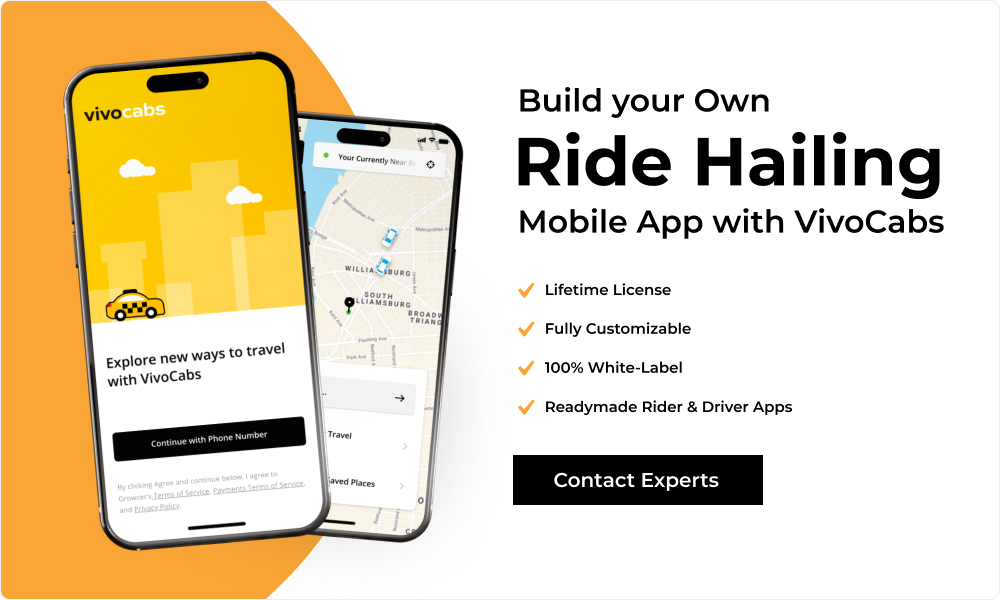
VivoCabs is a white-label ride-hailing software designed to help entrepreneurs, taxi companies, fleet operators, and mobility startups launch fully branded ride-hailing platforms without building everything from scratch. Equipped with a comprehensive set of ready-to-use features, it allows businesses to focus on acquiring customers, onboarding drivers, and scaling operations instead of managing lengthy development cycles.
Whether you’re planning to launch a local taxi booking service, an airport transfer platform, a corporate transportation solution, a chauffeur service, or a multi-city ride-hailing marketplace, VivoCabs provides a scalable and customizable foundation that significantly reduces development time while supporting future business growth.
Why Choose VivoCabs for Ride-Hailing App Development?
VivoCabs comes equipped with all the essential modules required to operate a modern ride-hailing business, including dedicated rider and driver apps and an admin dashboard. Instead of building these components individually, businesses receive a production-ready platform that can be customized to meet their branding and operational requirements.
- Fully White-Label
The software can be completely customized with your company’s branding, including your business name, logo, color scheme, domain, and mobile applications. This allows you to launch a platform that reflects your brand identity.
- Faster Time-to-Market
VivoCabs significantly accelerates deployment by providing a pre-built and thoroughly tested solution, enabling businesses to launch much faster and start generating revenue sooner.
- Highly Customizable & Scalable
VivoCabs is designed to support extensive customization, allowing businesses to modify workflows, pricing models, user interfaces, payment methods, vehicle categories, and business rules while maintaining a scalable architecture capable of supporting future expansion.
Key Features of VivoCabs
VivoCabs includes a comprehensive suite of features that simplify day-to-day operations while delivering a seamless experience for riders, drivers, and administrators.
| Rider Application | Driver Application | Admin Dashboard |
|---|---|---|
| Instant and scheduled ride bookings | Driver registration and verification | User and driver management |
| Real-time driver tracking | Ride request management | Vehicle management |
| Upfront fare estimation | GPS-enabled navigation | Commission configuration |
| Multiple vehicle categories | Online and offline availability | Dynamic pricing and fare management |
| Secure digital payment options | Earnings dashboard | Promotional campaigns and coupons |
| Promo codes and discount management | Digital wallet | Reports and business analytics |
| Ride history and digital receipts | Payout management | Customer support management |
| Ratings and reviews | Performance reports | Multi-language and multi-currency support |
| Push notifications | Trip history | Tax configuration |
| In-app communication with drivers | Ratings and feedback | Driver verification and compliance management |
Business Benefits of Choosing VivoCabs
Compared to custom development, VivoCabs offers several advantages, such as:
- Faster platform deployment and reduced time-to-market
- Lower development costs compared to building from scratch
- Proven and thoroughly tested functionality
- Reduced technical and project risks
- Complete branding flexibility with white-label capabilities
- Customizable source code
- Self-hosted deployment for greater control over data and infrastructure
- Scalable architecture to support business growth
- Ongoing feature enhancements and customization possibilities
Who Can Use VivoCabs?
VivoCabs is suitable for a wide range of transportation businesses and mobility entrepreneurs, including:
- Taxi booking businesses
- Ride-hailing startups
- Fleet management companies
- Airport transfer services
- Chauffeur service providers
- Corporate transportation providers
- Regional and city-wide mobility platforms
- Multi-service transportation marketplaces
Whether you’re entering the ride-hailing industry for the first time or digitizing an existing transportation business, VivoCabs provides a reliable, feature-rich, and scalable solution that helps you launch faster, reduce development complexity, and focus on growing your business with confidence.
Explore VivoCabs with a Free Live Demo
Final Thoughts
Ride-hailing continues to reshape the transportation industry, creating significant opportunities for entrepreneurs and mobility businesses. However, building a successful platform requires more than developing a mobile app. It demands thoughtful planning, reliable technology, user-centric design, robust security, and the flexibility to adapt to evolving market needs.
The right development approach depends on your budget, timeline, and long-term business objectives. While custom development offers complete flexibility, a white-label solution like VivoCabs can help you launch faster without compromising on essential features.
By delivering a seamless experience for both riders and drivers while continuously adapting to market demands, your ride-hailing business can build customer trust, encourage repeat usage, and scale successfully in an increasingly competitive mobility landscape.
Develop a Branded Ride-Hailing Platform for Your Business
Get StartedPopular Posts