

The global ride-hailing industry is booming. From metropolitan cities to mid-sized towns, entrepreneurs and mobility companies are racing to launch their own cab and ride services. At the heart of every ride-hailing operation is one critical decision: the software platform you choose to power it.
As you explore your options, you’ll quickly find yourself navigating two very different worlds: Software as a Service (SaaS) platforms and self-hosted software solutions. Both have their place, and both can power successful ride-hailing businesses. But depending on your goals, budget, and vision for growth, one will almost certainly serve you better than the other.
In this guide, we’ll break down the key differences between SaaS and self-hosted ride-hailing software, explore the real-world implications of each model, and help you understand which approach makes the most sense for your business, whether you’re launching your first taxi app or scaling an established fleet.
Table of Contents
Understanding the Two Models
What is SaaS Ride-Hailing Software?
SaaS (Software as a Service) platforms are cloud-based solutions where the software is hosted, maintained, and upgraded by a third-party vendor. You pay a subscription fee, typically monthly or per-trip, to access the platform. Popular examples include white-label SaaS taxi software providers that let businesses launch a branded app without building anything from scratch.
With SaaS, you’re essentially renting the software. You get access to an existing infrastructure, you log in, configure your settings, and you’re live. There’s minimal technical overhead, and the barrier to entry is low.
What is Self-Hosted Ride-Hailing Software?
Self-hosted software, on the other hand, is installed and operated on your own servers or cloud infrastructure. You own a license to the software, or in some cases, the full source code, and you’re responsible for deployment, hosting, and management.
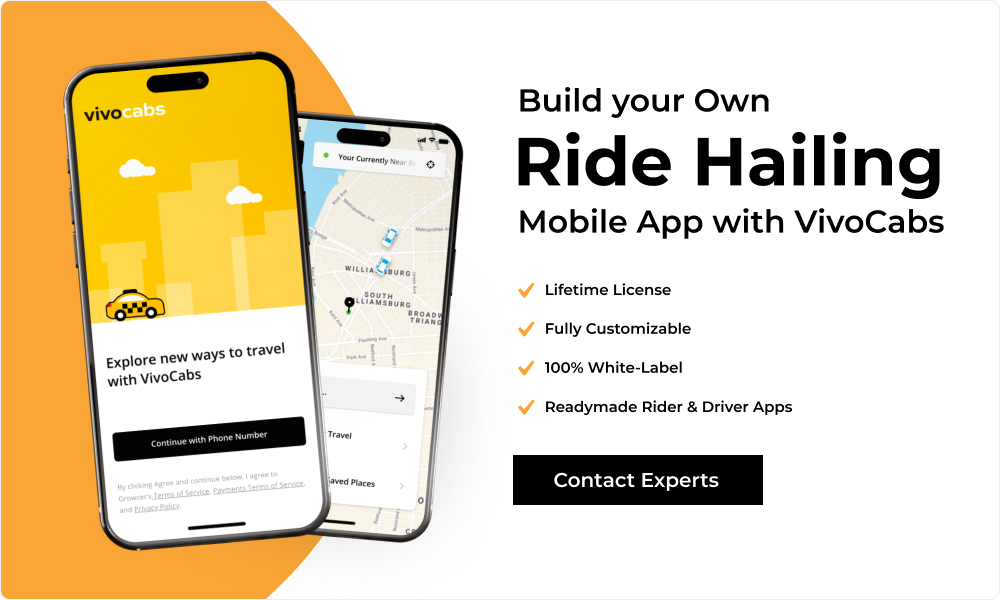
This is the model adopted by solutions like VivoCabs, a self-hosted ride-hailing software platform that gives businesses complete control over their technology stack, data, and branding. Instead of paying indefinitely for access to someone else’s platform, you invest once and run the software on your own terms.
Leverage a Robust Readymade Software for a Faster Market Entry
Comparing the Key Factors
1. Cost Structure: Ongoing Rent vs. One-Time Investment
One of the most significant differences between SaaS and self-hosted software is how you pay for it, and what that means over time.
SaaS platforms typically charge on a subscription basis. Some charge a flat monthly fee; others take a cut per completed ride, per driver seat, or per active user. In the early stages, these costs may seem manageable. But as your business grows, more drivers, more rides, more cities, your SaaS bill often grows right alongside it.
With self-hosted software like VivoCabs, you pay a one-time licensing fee to acquire the platform. After that, your primary ongoing costs are hosting (typically a VPS or cloud server) and any optional support or update plans you choose. There’s no per-ride tax on your success. The more your business grows, the more valuable your upfront investment becomes.
Over a 3-5 year horizon, many self-hosted customers find they spend significantly less than they would have on a comparable SaaS subscription, while gaining far more control over their platform.
2. Data Ownership and Privacy
In the ride-hailing business, data is everything. Driver locations, passenger trip histories, payment records, behavioral patterns, this information is not just operationally useful; it’s commercially valuable.
With SaaS platforms, your data lives on the vendor’s servers. You trust them to protect it, not to use it for their own purposes, and to give you access to it if you ever decide to leave. Depending on the vendor’s terms, your data may be subject to their privacy policies, third-party sharing agreements, or data residency laws that don’t align with your local regulations.
Self-hosted solutions like VivoCabs put you in full control. Your data stays on your servers, in your jurisdiction, under your policies. This is particularly critical for businesses operating in regions with strict data localization laws, such as India, the EU, or the Middle East, where user data must be stored domestically.
For any operator serious about building a long-term brand and maintaining user trust, data sovereignty is not a minor consideration. It’s a business-critical one.
3. Customization and Brand Identity
When you launch a ride-hailing service, you want users to recognize and remember your brand, not the underlying software vendor powering it.
SaaS platforms offer varying degrees of white-labeling. Some allow basic logo changes and color schemes; others provide more advanced customization. But at their core, SaaS solutions are built for the masses; the features, user flows, and logic are standardized to work across many different customers. Deep customizations are often unavailable, slow to implement, or come at a premium.
With a self-hosted software like VivoCabs, you have full access to the architecture. Want to add a unique surge pricing model? Build a loyalty program? Integrate with a local payment gateway that no SaaS vendor supports? All of this is possible when you control the codebase. Your platform can evolve exactly the way your business needs it to, without waiting for a vendor’s product roadmap.
This level of flexibility is especially important for operators in emerging markets or niche verticals, such as corporate transportation, airport transfers, and medical rides, where off-the-shelf features rarely fit perfectly.
4. Scalability
Both models can scale, but they do so differently.
SaaS platforms handle the infrastructure complexity for you. When your user base grows, the vendor provisions more compute, manages load balancing, and ensures uptime. This is genuinely convenient, especially for early-stage businesses without dedicated technical teams.
Self-hosted platforms require you to manage your own infrastructure scaling, but this also means you choose your own cloud provider, optimize for your specific geography, and pay for exactly the compute you need without vendor markup. Tools like AWS, Google Cloud, DigitalOcean, or local data centers give you a wide range of options to scale efficiently and cost-effectively.
Solutions like VivoCabs are built with scalability in mind, making it feasible for small operators to start lean and grow their infrastructure progressively, matching investment to growth rather than paying for capacity you don’t yet need.
5. Vendor Lock-In and Business Risk
One underappreciated risk of SaaS is dependency. Your business becomes tied to decisions made by a company you don’t control.
What happens if the vendor raises prices significantly next year? What if they discontinue a feature you rely on? What if they’re acquired and the new owner pivots the product? What if they go out of business entirely? In any of these scenarios, your ride-hailing operation faces serious disruption.
Self-hosted software eliminates this category of risk. Once you license VivoCabs, the software is yours to use. No third party can pull the rug from under your operation. This kind of stability is especially important for investors and operators thinking in multi-year timeframes.
6. Setup Speed and Technical Requirements
This is the one area where SaaS holds a genuine, meaningful advantage, and it’s worth acknowledging honestly.
SaaS platforms can be up and running in hours. Create an account, configure your settings, and your platform is live. For entrepreneurs who want to validate a market quickly, run a pilot, or simply don’t have technical expertise on hand, this speed-to-market advantage is real and significant.
Self-hosted solutions like VivoCabs require server provisioning, software installation, domain configuration, SSL setup, and testing before you go live. This can take anywhere from a few days to a couple of weeks, depending on your technical capabilities. That said, reputable self-hosted providers offer support, documentation, and sometimes managed deployment services that can reduce this complexity substantially.
The key question is: are you optimizing for speed in week one, or for control and economics over the next five years? For most serious operators, the latter wins.
Move Beyond Subscriptions And Own Your Platform
Side-by-Side Comparison
| Feature | SaaS Solution | Self-Hosted | Winner |
| Data Ownership | Vendor holds data | 100% yours | Self-Hosted ✓ |
| Monthly Fees | Ongoing per-trip/seat cost | One-time license | Self-Hosted ✓ |
| Customization | Limited to the vendor plan | Full source control | Self-Hosted ✓ |
| Scalability | Auto-scale by vendor | Scale on your infra | Tie |
| Setup Speed | Instant (minutes) | Days to weeks | SaaS ✓ |
| Branding | Shared or co-branded | 100% white-label | Self-Hosted ✓ |
| Compliance | Depends on vendor policy | Full control | Self-Hosted ✓ |
| Long-term Cost | Grows with revenue | Fixed after the license | Self-Hosted ✓ |
Who Should Choose SaaS?
To be fair, SaaS ride-hailing software is the right choice in specific situations:
- You’re running a short-term pilot or proof-of-concept and need to launch within days
- You have zero technical team and no budget for server management
- You operate in a single small market with a very small fleet and low ride volume
- You’re testing the business model before committing to a larger investment
In these scenarios, the convenience and low upfront commitment of SaaS make it a sensible starting point. There’s nothing wrong with beginning there, just be aware of the ceiling.
Who Should Choose Self-Hosted Software?
Self-hosted solutions are better suited for a broader and more ambitious range of operators:
- Entrepreneurs launching a ride-hailing business with serious growth ambitions
- Fleet operators and taxi companies want to digitize under their own brand
- Businesses in regions with strict data residency or compliance requirements
- Operators who want to differentiate through unique features and user experiences
- Companies looking to maximize ROI over a 2-5 year investment horizon
- Businesses frustrated with SaaS pricing that scales against them as they grow
If you recognize yourself in more than one of these bullet points, self-hosted software is almost certainly the better path.
Spotlight: VivoCabs, Built for Serious Operators
Among self-hosted ride-hailing platforms, VivoCabs stands out as a comprehensive solution designed from the ground up for businesses that want to own their technology.
What Makes VivoCabs Different
VivoCabs is a fully self-hosted, white-label ride-hailing software that gives operators complete ownership of their platform, from the driver and passenger apps to the admin dashboard and dispatch system. Here’s what sets it apart:
- Complete Source Code Ownership: Unlike some self-hosted products that deliver compiled binaries, VivoCabs provides access to the full source code, giving your technical team total freedom to customize, extend, and integrate.
- White-Label Ready: Every customer-facing touchpoint, passenger app, driver app, and website is fully brandable. Your users will only ever see your brand.
- One-Time Licensing: Pay once, use forever. No recurring per-ride fees, no monthly software subscriptions that erode your margins.
- Multi-City Support: VivoCabs supports operations across multiple zones, cities, and service types from a single admin panel, ideal for businesses planning regional expansion.
- Comprehensive Admin Dashboard: Real-time tracking, driver management, fare configuration, promo codes, analytics, and more, all under one roof.
- Payment Gateway Flexibility: Integrate with the payment gateways most trusted in your market, rather than being limited to whatever a SaaS vendor has pre-built.
- Dedicated Support: VivoCabs offers implementation support to help operators get up and running, reducing the technical friction that typically comes with self-hosted deployments.
It’s not the right choice for someone who wants to test an idea over a weekend. But for operators who are serious about building a profitable, scalable, and differentiated ride-hailing business, VivoCabs delivers the depth of control and ownership that SaaS simply cannot match.
Making the Decision: A Final Framework
If you’re still weighing your options, use these three questions as your guide:
- How long do you plan to operate? If the answer is years, the economics of self-hosted software improve dramatically over time.
- How important is customization to your brand strategy? If differentiation matters, and in ride-hailing, it increasingly does, you need the freedom that only self-hosting delivers.
- How important is data control to your business and your customers? If you’re in a regulated market or building user trust as a core value, owning your data is non-negotiable.
For most entrepreneurs who are serious about launching a ride-hailing business, the answer points clearly toward self-hosted software, and platforms like VivoCabs make that choice more accessible than ever.
SaaS has its place, primarily for those in the exploration phase. But when it comes to building something real, something lasting, and something truly yours, the ownership model wins.
Schedule a Personalized Demo to See VivoCabs in Action
Frequently Asked Questions (FAQs)
Q 1. What is the main difference between SaaS and self-hosted ride-hailing software?
Ans. The primary difference lies in ownership and control. SaaS platforms are subscription-based and hosted by a third party, while self-hosted software like VivoCabs is installed on your own server, giving you full ownership of the platform, data, and customization capabilities.
Q 2. Is self-hosted ride-hailing software more cost-effective than SaaS?
Ans. Yes, in most long-term scenarios. SaaS platforms charge recurring fees (monthly or per ride), which increase as your business grows. Self-hosted solutions like VivoCabs involve a one-time licensing fee, making them more cost-efficient over time, especially for scaling businesses.
Q 3. Do I need technical expertise to run a self-hosted solution like VivoCabs?
Ans. Not necessarily. While self-hosted platforms require server setup and deployment, VivoCabs provides technical support, documentation, and deployment assistance to help you launch smoothly, even if you don’t have an in-house tech team.
Q 4. How long does it take to launch a ride-hailing platform with VivoCabs?
Ans. Typically, a self-hosted solution like VivoCabs can be deployed within a few days to a couple of weeks, depending on your customization needs and infrastructure readiness.
Q 5. Is VivoCabs suitable for multi-city or large-scale operations?
Ans. Absolutely. VivoCabs is built to support multi-city operations, multiple service types, and scalable infrastructure, making it ideal for both startups and growing ride-hailing businesses.
Q 6. What are the risks of using SaaS ride-hailing software?
Ans. SaaS platforms come with risks such as vendor lock-in, increasing costs, limited customization, and dependency on the provider’s policies and uptime. These risks can impact your business as you scale
Looking for a Reliable Way to Launch Your Ride-Hailing Platform?
Get in TouchPopular Posts